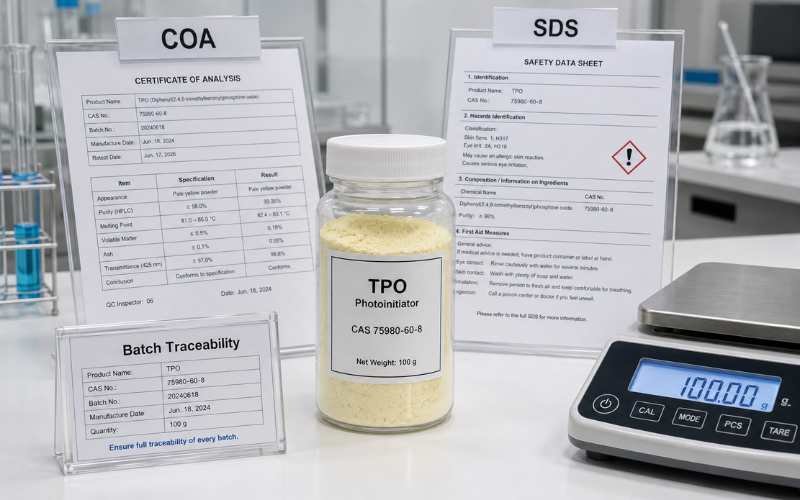
Photoinitiator 907 is a Type I free-radical UV photoinitiator used to cure acrylate-based UV inks, coatings, adhesives, PCB inks, and photoresist-related systems. Its CAS number is 71868-10-5, and its chemical name is 2-Methyl-4'-(methylthio)-2-morpholinopropiophenone.
For industrial buyers, Photoinitiator 907 is mainly selected when a UV formulation needs better curing in pigmented systems, especially dark UV ink, screen ink, offset ink, PCB solder mask ink, and electronic coating materials. It can work alone in some formulas, but many R&D teams test it with ITX, DETX, 184, TPO, or 819 to balance cure speed, surface cure, odor, yellowing, and total cost.
| Buyer Question | Direct Answer |
|---|---|
| What is Photoinitiator 907? | A Type I free-radical UV photoinitiator |
| CAS number | 71868-10-5 |
| Best-fit applications | Pigmented UV ink, UV coating, PCB ink, UV adhesive |
| Common test dosage | 2–6% w/w as a lab screening range |
| Strong point | Useful in difficult pigmented UV curing systems |
| Main caution | Check SDS, lamp spectrum, pigment load, odor, yellowing, and compliance |
| Buying documents | COA, SDS, TDS, REACH, RoHS, export documents |
If you are buying Photoinitiator 907 for production, do not judge it only by purity or price per kilogram. The right question is whether 907 can reduce failed cure, rework, lamp passes, customer complaints, and documentation risk in your exact UV system.
Introduction: Most 907 Questions Start After a Cure Problem
Many buyers contact me after a dark UV ink stays tacky, a PCB ink cures too slowly, or a coating line needs extra lamp passes. At that point, they often ask a simple question: “Should we use Photoinitiator 907?”
The simple answer is useful, but not enough. A CAS number will not fix poor cure. A low price will not protect you from odor complaints, yellowing, failed adhesion, or delayed export documents.
From my work with UV ink, UV coating, UV adhesive, and electronic material buyers, I have learned one hard lesson: Photoinitiator 907 is not just a raw material. It is a curing decision. You need to match it with the lamp, pigment, resin, film thickness, substrate, and target market before scaling up.
What is Photoinitiator 907?
Photoinitiator 907 is a solid Type I cleavage photoinitiator that absorbs UV light and generates free radicals to start polymerization in UV-curable acrylate systems. It is commonly used in UV inks, UV coatings, UV adhesives, PCB inks, and photoresist-related formulations.
The chemical identity of Photoinitiator 907 is listed by PubChem under CAS 71868-10-5. The ECHA substance record for CAS 71868-10-5 also identifies the substance under its regulatory chemical record.
In plain production language, 907 helps a liquid UV formulation become a solid cured film. The UV lamp provides energy. The photoinitiator absorbs that energy. Then it creates radicals that start polymer chain growth in acrylate monomers and oligomers.
This is why 907 matters in UV curing. Without the right photoinitiator package, even a good resin system can fail on speed, adhesion, hardness, odor, or cure depth.
Photoinitiator 907 Technical Data at a Glance
The values below are common reference points used in supplier TDS documents and public chemical records. Always confirm the final specification with the supplier’s latest COA, SDS, and TDS before commercial use.
| Property | Typical Reference | Procurement Note |
|---|---|---|
| Product name | Photoinitiator 907 | Also called PI 907, Irgacure 907, or Omnirad 907 |
| CAS number | 71868-10-5 | Use this for SDS, customs, and regulatory checks |
| Chemical name | 2-Methyl-4'-(methylthio)-2-morpholinopropiophenone | Check naming consistency across documents |
| Molecular formula | C15H21NO2S | Useful for technical records |
| Molecular weight | 279.40 g/mol | Helpful for formulation calculations |
| Appearance | White to light yellow crystalline powder | Color variation should be checked batch by batch |
| Type | Type I free-radical photoinitiator | Cleavage-type radical generator |
| Common test dosage | 2–6% w/w | Start range only; final dosage needs testing |
| Main applications | UV ink, UV coating, UV adhesive, PCB ink | Best evaluated by actual formulation |
| Storage | Cool, dry, sealed, protected from light | Poor storage can affect stability |
IGM Resins describes Omnirad 907 product information as a photoinitiator used for photopolymerization of unsaturated prepolymers such as acrylates. This matches how most industrial buyers use 907 in UV-curable systems.
My advice is direct: do not approve 907 only because the COA shows high purity. Ask for batch consistency, moisture, ash, impurity control, packaging condition, shelf life, and document traceability.
How Does Photoinitiator 907 Work in UV Curing?
Photoinitiator 907 absorbs UV energy and splits into active radical species. These radicals react with acrylate double bonds in monomers and oligomers. The liquid formulation then polymerizes into a solid cured film.
A Sigma-Aldrich technical guide on photoinitiators in UV curing explains how photoinitiators convert absorbed light energy into chemical initiating species. That is the foundation of 907’s role in UV curing.
In real production, however, the cure result depends on the whole system. I rarely start by telling buyers to increase the 907 dosage. I first ask:
- What lamp do you use: mercury, LED UV, or mixed UV?
- What wavelength and power reach the film?
- What is the wet film thickness?
- Is the ink clear, white, black, blue, red, or metallic?
- What substrate do you print or coat?
- What is the failure: tack, poor adhesion, low hardness, odor, or slow through-cure?
More 907 does not always mean better curing. If the lamp energy cannot reach the lower film layer, a higher dosage may only raise odor, yellowing, residue concern, and cost.
What is Photoinitiator 907 Used For?
Photoinitiator 907 is used in industrial UV curing systems where strong radical generation is needed, especially in pigmented or difficult-to-cure formulations.
A Photoinitiator 907 TDS from Haihang lists use areas such as lithographic inks, silk screen inks, flexo inks, plastic coatings, composites, electronics, and overprint systems. These match the most common buyer discussions I see in UV ink and coating projects.
| Application | Why 907 Is Used | Key Test | Buyer Risk |
|---|---|---|---|
| UV offset ink | Supports pigmented ink curing | Tack-free time, rub resistance, odor | Slow cure under dark pigment |
| UV screen ink | Helps thicker ink films | Through-cure, adhesion, flexibility | Surface cure may hide weak bottom cure |
| UV flexo ink | Supports fast line curing | Line speed, viscosity stability, rubs | Lamp aging changes curing result |
| Plastic coating | Helps pigmented coating cure | Adhesion, scratch resistance, yellowing | Some plastics need surface treatment |
| PCB ink / solder mask ink | Used in electronics-related UV systems | Cure depth, resolution, compliance | Documentation pressure is higher |
| UV adhesive | Supports radical UV curing | Bond strength, shrinkage, residue | Not suitable for every adhesive system |
| Pigmented UV coating | Helps when pigment blocks UV light | MEK rubs, gloss, cure depth | Overdose can affect odor and color |
For UVIXE buyers, the highest-value use case is often not a simple clear varnish. It is a darker ink, PCB material, or pigmented coating where a normal initiator package cannot meet cure speed and reliability at the same time.
Which Buyer Should Choose Photoinitiator 907?
Photoinitiator 907 fits some buyers better than others. This is where many generic supplier pages fail. They list applications, but they do not help buyers decide.
| Buyer Type | When 907 Makes Sense | What to Check Before Buying |
|---|---|---|
| UV ink factory | Dark ink, screen ink, offset ink, pigmented flexo ink | Pigment absorption, lamp intensity, odor, rub resistance |
| UV coating manufacturer | Colored coating, plastic coating, industrial coating | Substrate adhesion, gloss, yellowing, cure depth |
| PCB ink buyer | PCB solder mask ink or photoresist-related system | SDS, SVHC review, customer restrictions, cure depth |
| UV adhesive producer | Radical UV adhesive system needing faster cure | Bond strength, shrinkage, residue, substrate match |
| 3D printing resin company | Specialty resin testing, not general consumer use | Wavelength, color, cure depth, final safety target |
| Distributor / trader | Bulk supply for industrial buyers | COA, SDS, TDS, labels, REACH/RoHS, lead time |
| Lab / R&D buyer | Early-stage formula screening | Small sample, dosage ladder, test records |
If your factory prints black UV ink or makes PCB-related UV materials, 907 deserves serious testing. If you make a clear low-yellowing coating, you may need to compare 907 with Photoinitiator 184, 1173, TPO, or 819 before choosing.
Why 907 Performs Well in Pigmented UV Systems
Pigments make UV curing harder. They absorb, scatter, and block UV light. Black, blue, red, and some inorganic pigments can reduce the energy that reaches the lower part of the ink or coating film.
This is why Photoinitiator 907 is often selected for pigmented UV inks and coatings. It can help difficult systems generate radicals more effectively than some initiators used in clear coatings.
In UVIXE sample discussions, I often see the same mistake. A buyer has a black UV ink cure problem, then increases 907 from 3% to 6% without checking the lamp or pigment. Sometimes the issue is not low initiator loading. It is weak lamp energy at the film bottom.
Before increasing dosage, test these points:
- Pigment color and pigment loading
- UV absorption of the pigment
- Wet and cured film thickness
- Lamp type and output
- Conveyor speed or exposure time
- Surface cure and bottom cure separately
- Odor and yellowing after cure
The goal is not to use more 907. The goal is to reach stable cure with the lowest practical risk.
Is Photoinitiator 907 Suitable for LED UV?
Photoinitiator 907 is more commonly discussed with traditional mercury UV systems and pigmented UV formulations. For LED UV curing, especially 385 nm or 395 nm systems, buyers should test carefully instead of assuming direct suitability.
LED UV systems provide narrower wavelength output than mercury lamps. That means the photoinitiator package must match the LED emission range. In some LED UV systems, TPO, TPO-L, or 819 may be stronger starting points because they absorb better at longer wavelengths.
| UV System | 907 Suitability | Buyer Decision |
|---|---|---|
| Mercury UV lamp | Commonly tested in UV ink and coating systems | Strong candidate for pigmented systems |
| 365 nm UV system | May be tested depending on formulation | Check actual cure and film depth |
| 385 nm LED UV | Needs careful testing | Compare with TPO photoinitiator |
| 395 nm LED UV | Usually needs stronger long-wavelength package | Compare with TPO-L or 819 |
| Mixed lamp system | Possible in combination packages | Test 907 with sensitizers or other initiators |
If you are converting from mercury UV to LED UV, do not simply keep the same 907 formula. Send your lamp wavelength, film thickness, pigment color, and target cure speed before scaling.
Photoinitiator 907 vs 184 vs ITX vs 369 vs TPO vs 819
A buyer should not choose a photoinitiator by name only. Each product solves a different curing problem.
| If Your Problem Is... | First Products to Test | Why | Avoid This Mistake |
|---|---|---|---|
| Clear coating needs clean cure | 184, 1173 | Often suitable for clear systems | Do not use 907 if low yellowing is the main target |
| Black UV ink cures slowly | 907 + ITX / DETX | Supports pigmented ink testing | Do not increase 907 blindly |
| LED UV coating needs longer wavelength absorption | TPO, TPO-L, 819 | Better fit for many LED systems | Do not copy a mercury UV formula |
| Thick white system needs depth cure | 819 / BAPO | Stronger depth cure profile | Do not judge only by surface tack |
| PCB ink needs curing and compliance control | 907, 369, tested packages | Strong reactivity, but documents matter | Do not ignore SDS and customer restrictions |
| UV adhesive needs fast cure | 184, TPO, 907, tested package | Depends on adhesive chemistry | Do not choose without bond testing |
You can compare related UVIXE product pages here: Photoinitiator 184 supplier, TPO photoinitiator supplier, Photoinitiator TPO-L supplier, and BAPO 819 photoinitiator guide.
If you are comparing 907 with 184, TPO, TPO-L, ITX, DETX, 369, or 819, send UVIXE your cure problem. We can suggest a practical sample set for lab screening.
Should You Use Photoinitiator 907 Alone or With ITX, DETX, or 184?
Photoinitiator 907 can work alone in some UV systems after testing. In many pigmented UV ink and coating formulas, it is tested with sensitizers or other initiators.
Sinocure states that Photoinitiator 907 can be used alone after testing or mixed with initiators such as 184 and ITX, with a reference dosage range often shown around 2–6%.
Practical combination logic:
- 907 + ITX: often tested in pigmented UV ink systems.
- 907 + DETX: may support ink systems where sensitization is needed.
- 907 + 184: may help balance surface cure and general reactivity.
- 907 + TPO: may be tested when longer wavelength response matters.
- 907 + 819: may be tested when depth cure is difficult.
The wrong way is to copy a formula from another factory. The right way is to build a small dosage ladder and test against the real pigment, resin, lamp, and line speed.
Recommended Dosage and Lab Testing Method
Many commercial TDS documents list Photoinitiator 907 in a 2–6% w/w reference range. This is a useful lab starting point, not a fixed production formula.
| 907 Loading | Suggested Test System | What to Measure | Decision Point |
|---|---|---|---|
| 2% | Low-pigment or thin film system | Tack-free time, adhesion, gloss | Check if cure is already enough |
| 3% | Standard pigmented UV ink trial | Surface cure, MEK rubs, odor | Good early screening level |
| 4% | Dark ink or thicker coating | Through-cure, blocking, flexibility | Compare with 907 + sensitizer |
| 5% | Difficult pigment system | Cure depth, yellowing, residue concern | Watch odor and compliance risk |
| 6% | Upper screening point | Full cure, migration concern, cost | Do not scale without safety review |
For production screening, I suggest tracking:
- Tack-free time
- Adhesion on final substrate
- MEK rub resistance
- Surface gloss
- Yellowing after curing
- Odor after curing
- Blocking after stacking
- Flexibility or crack resistance
- Residual photoinitiator concern
- Lamp energy per cured square meter
If your current 907 loading is already above 5% and the system still cures slowly, do not keep increasing dosage. Send your lamp type, pigment color, film thickness, and target line speed to UVIXE for a more practical review.
What Should PCB Ink Buyers Check Before Using 907?
PCB ink and electronics-related buyers need stricter control than general coating buyers. A cure failure can cause performance problems, but a documentation failure can stop the project before production.
Peters published a white paper discussing SVHC classified photoinitiator challenges in PCB production, including concerns around photoinitiators used in electronics materials. This is why PCB buyers should not treat 907 as a normal commodity chemical.
PCB and electronics buyers should check:
- Latest SDS version
- EU regulatory review if selling into Europe
- Customer-restricted substance list
- Cure depth in solder mask or related ink layer
- Final hardness and adhesion
- Heat resistance after cure
- Residual odor and extractables concern
- COA traceability by batch
- Supplier ability to provide repeat documents
For PCB solder mask ink, the buyer’s customer may care more about compliance files than small price differences. In this market, a cheap batch without clear documents is not cheap. It is a risk.
When Should You Avoid Photoinitiator 907?
Photoinitiator 907 is useful, but it is not suitable for every UV system. Avoid treating it as a universal initiator.
You should be cautious with 907 when:
- Your main target is very low yellowing.
- Your system uses only 385 nm or 395 nm LED UV without testing.
- Your end use has strict migration or food-contact concerns.
- Your customer rejects materials with unclear SDS or regulatory status.
- Your formula already has odor problems.
- Your clear coating can cure well with 184, 1173, TPO, or another cleaner package.
- Your supplier cannot provide COA, SDS, TDS, and traceable batch documents.
This does not mean 907 is bad. It means 907 should be chosen for the right reason. For difficult pigmented systems, it may be valuable. For clear low-yellowing systems, another initiator may be easier.
Photoinitiator 907 Total Cost of Ownership
Many buyers ask for the lowest Photoinitiator 907 price. I understand that pressure. But UV curing cost is not only price per kilogram.
The real number is cost per approved cured sheet, label, printed part, coating layer, or bonded part.
| Cost Factor | What Procurement Sees | What Production Actually Pays For |
|---|---|---|
| Raw material price | USD/kg or RMB/kg | Only one part of total curing cost |
| Dosage | 2–6% formula loading | Higher dosage can raise cost and odor |
| Cure speed | Lamp pass count | Slow cure reduces line output |
| Lamp energy | UV lamp power | Extra passes increase electricity and heat |
| Scrap rate | Rejected batches | Poor cure creates waste and delay |
| Rework | Extra curing or recoating | Labor, lamp time, and schedule loss |
| Compliance | SDS and customer documents | Missing files can block shipment |
| Storage | Drum or carton stock | Poor storage may reduce stability |
| Batch variation | COA value | Variation can change formula behavior |
When I review 907 sourcing with buyers, I do not ask only for target price. I ask about cure failure cost. If one rejected batch costs more than the price difference between two suppliers, the cheaper material may be the more expensive decision.
Safety, Regulatory, and Export Documentation
Photoinitiator 907 requires careful safety and regulatory review, especially for buyers in Europe, electronics, packaging, printing ink, and distribution.
The ECHA substance record for CAS 71868-10-5 should be checked when the final product enters EU-related markets. Buyers should also review the latest SDS instead of relying on old files copied from the internet.
Before buying Photoinitiator 907, request:
- Latest SDS
- TDS
- COA for the exact batch
- REACH statement when needed
- RoHS statement when needed
- GHS label information
- Transport and customs documents
- Shelf-life and storage statement
- End-use restriction review for sensitive applications
- Batch traceability record
For food packaging, toys, medical devices, and indirect food-contact applications, do not make assumptions. Ask for a specific compliance review. Migration, residue, and customer standards may matter more than initial cure speed.
How to Choose a Photoinitiator 907 Supplier
A serious Photoinitiator 907 supplier should reduce both technical risk and supply risk. A quote alone is not enough.
| Supplier Audit Point | Why It Matters | Good Signal |
|---|---|---|
| Batch COA | Confirms delivered quality | COA matches label and shipment |
| SDS and TDS | Supports safety review | Latest files available before order |
| Purity control | Supports stable cure | Clear specification range |
| Moisture and ash | Helps formulation stability | Controlled and reported |
| Batch consistency | Reduces reformulation risk | Repeatable COA history |
| Sample MOQ | Allows lab screening | Small sample available |
| Bulk MOQ | Helps inventory planning | Clear MOQ by package |
| Lead time | Affects production schedule | Stable production and shipment plan |
| Export packaging | Reduces damage risk | Sealed, labeled, export-ready cartons or drums |
| Customs support | Helps distributors | HS code and shipping documents prepared |
| Technical response | Saves R&D time | Supplier asks about lamp, pigment, and application |
At UVIXE, we focus on B2B buyers who need stable photoinitiator supply for UV coating, UV ink, UV adhesive, 3D printing resin, and electronic material systems. You can review our Photoinitiator 907 supplier page or compare related products through Photoinitiator 184, TPO, and TPO-L.
If your procurement and R&D teams need a shared technical baseline, our guide on what a photoinitiator does and our page on what affects UV curing speed can help before sample testing.
Common Buying Mistakes With Photoinitiator 907
Mistake 1: Buying Only by Price Per Kilogram
A lower price can look good on a spreadsheet. But if the material causes unstable cure, extra lamp passes, odor complaints, or rejected batches, the real cost rises.
Mistake 2: Treating 907 as a Universal Replacement
Photoinitiator 907 should not be swapped with 184, ITX, DETX, TPO, 369, or 819 without testing. Each initiator has a different absorption and performance profile.
Mistake 3: Ignoring the Lamp Spectrum
Mercury lamps, 365 nm UV systems, 385 nm LED UV, and 395 nm LED UV do not perform the same way. The initiator package must match the available wavelength.
Mistake 4: Scaling Too Fast From Lab to Production
A small lab drawdown can pass while a high-speed production line fails. Line speed, lamp aging, cooling, substrate movement, and film thickness all matter.
Mistake 5: Using Old Compliance Documents
This is common with distributors. Old SDS files, unclear labels, and missing REACH or RoHS statements can delay shipments or fail customer audits.
FAQ About Photoinitiator 907
What is Photoinitiator 907?
Photoinitiator 907 is a Type I free-radical UV photoinitiator used to start polymerization in acrylate-based UV inks, coatings, adhesives, PCB inks, and photoresist-related systems.
What is the CAS number of Photoinitiator 907?
The CAS number of Photoinitiator 907 is 71868-10-5. Buyers should use this number when checking SDS, COA, customs documents, and regulatory records.
Is Photoinitiator 907 a Type I photoinitiator?
Yes. Photoinitiator 907 is generally classified as a Type I cleavage photoinitiator. It generates free radicals after absorbing UV light.
What is Photoinitiator 907 used for?
Photoinitiator 907 is used in UV offset ink, screen ink, flexo ink, pigmented UV coating, plastic coating, UV adhesive, PCB ink, solder mask ink, and electronics-related UV curing systems.
Is Photoinitiator 907 suitable for black UV ink?
Yes, Photoinitiator 907 is often tested in black UV ink and other dark pigmented systems. Buyers should check pigment absorption, film thickness, lamp output, odor, and through-cure.
Is Photoinitiator 907 suitable for LED UV curing?
It depends on the LED wavelength and formulation. For 385 nm and 395 nm LED UV systems, buyers should compare 907 with TPO, TPO-L, and 819 before choosing.
Can Photoinitiator 907 be used in UV coatings?
Yes. Photoinitiator 907 can be used in UV coatings, especially pigmented coatings and plastic coatings. For clear low-yellowing coatings, 184, 1173, TPO, or other initiators may also be tested.
What is the recommended dosage of Photoinitiator 907?
A common lab screening range is 2–6% w/w, but the final dosage depends on pigment loading, lamp type, resin system, film thickness, cure speed, and safety requirements.
Can Photoinitiator 907 be used with ITX?
Yes. 907 is often tested with ITX in UV ink systems. The combination depends on lamp output, pigment absorption, film thickness, resin system, and target properties.
What is the difference between Photoinitiator 907 and 184?
Photoinitiator 907 is often selected for pigmented UV systems, while Photoinitiator 184 is often used in clear coatings and varnishes. The final choice depends on cure depth, yellowing, odor, and compliance needs.
What is the difference between Photoinitiator 907 and 369?
Both are high-activity photoinitiators used in UV systems, but they are not direct replacements. Buyers should compare curing performance, regulatory pressure, end-use restrictions, and supplier documentation.
Is Photoinitiator 907 safe?
Photoinitiator 907 must be handled according to the latest SDS and local regulations. Buyers should review hazard classification, PPE, storage, transport, and final application restrictions before use.
What documents should I request before buying Photoinitiator 907?
You should request COA, SDS, TDS, REACH statement, RoHS statement if needed, transport documents, label information, shelf-life data, and batch traceability records.
Make 907 a Controlled Choice, Not a Guess
Photoinitiator 907 is a strong option for pigmented UV curing systems, UV inks, coatings, adhesives, PCB inks, and electronic materials. But it is not a universal fix.
The right decision depends on lamp wavelength, pigment load, film thickness, substrate, resin system, compliance target, and production cost. Procurement should not buy only by price. R&D should not increase dosage without checking the cure bottleneck. Distributors should not ship material without updated documents.
The best 907 purchase is the batch that cures reliably, ships smoothly, and passes your customer’s technical review.
Send UVIXE Your UV System Before You Buy 907
If you are evaluating Photoinitiator 907 for UV ink, UV coating, UV adhesive, PCB ink, solder mask ink, or a new UV material project, send UVIXE your basic formulation conditions before bulk ordering.
Please include:
- UV application: ink, coating, adhesive, PCB, resin, or other system
- Lamp type: mercury lamp, LED UV, or mixed system
- Lamp wavelength: 365 nm, 385 nm, 395 nm, or other range
- Pigment color and pigment loading
- Film thickness
- Substrate
- Target market
- Required documents
- Sample quantity or annual demand
- Expected lead time
UVIXE can support B2B buyers with Photoinitiator 907 samples, quotation, COA, SDS, TDS, packaging details, and shipment planning. You can start from our Photoinitiator 907 supplier page or contact us directly through Contact UVIXE.