BAPO Photoinitiator 819 is a Type I free-radical photoinitiator used for deep curing in UV coatings, UV inks, UV adhesives, and SLA/DLP 3D printing resins.
Its chemical name is phenylbis(2,4,6-trimethylbenzoyl)phosphine oxide, and its CAS number is 162881-26-7, listed by ECHA for chemical identity and PubChem compound data.
Use BAPO 819 when your formulation needs through cure, pigmented-system curing, UV-LED response, or lower yellowing than older amine-heavy systems. Do not choose it only by price. Match it with wavelength, film thickness, pigment load, resin chemistry, safety requirements, and batch consistency.
The Real Problem BAPO 819 Solves
In UV production, cure failure does not always look serious at first.
A coating may feel dry on the surface but stay soft underneath. A white UV ink may pass a quick finger test but fail rub resistance. A 3D resin may cure fast but lose fine detail. An adhesive may bond in the lab and fail on a real assembly line.
That is why buyers ask about BAPO Photoinitiator 819.
The problem is not only “how fast can it cure?” The real question is: Can it deliver enough cure depth under your actual wavelength, pigment load, film thickness, and production speed?
As a UVIXE photoinitiator supplier, I rarely recommend 819 without asking application questions first. A good photoinitiator choice starts with the failure mode, not the product name.
Quick Selection Matrix: Should You Test BAPO 819?
| Your UV Curing Problem | Should You Test BAPO 819? | Why |
|---|---|---|
| White UV coating has soft bottom cure | Yes | BAPO 819 supports deeper curing in pigmented films |
| Black or opaque UV ink fails rub resistance | Yes | Dense pigments reduce light penetration |
| 395 nm or 405 nm UV-LED resin cures too slowly | Yes, but test dosage carefully | 819 can support LED response, but over-cure can reduce detail |
| Clear thin varnish cures well | Maybe not | 184, 1173, TPO, or TPO-L may be enough |
| Surface remains tacky but bottom cure is good | Not always | Oxygen inhibition may need blend support |
| UV adhesive bond line is too thick for full cure | Yes | Cure depth matters more than surface speed |
| Food packaging ink needs low migration approval | Only after compliance review | End-use regulation and migration testing matter |
| Distributor needs stable industrial supply | Yes, if documents and batch control are strong | COA, SDS, TDS, packaging, and lead time matter |
My field note: When a customer says “819 did not work,” I first ask whether the failure is surface tack, bottom softness, poor adhesion, yellowing, or lamp mismatch. These are different problems. One photoinitiator cannot solve all of them in the same way.
What Is BAPO Photoinitiator 819?
BAPO Photoinitiator 819 is a bisacylphosphine oxide photoinitiator. In commercial UV curing, buyers may also call it:
- Photoinitiator 819
- PI 819
- BAPO
- Bisacylphosphine oxide photoinitiator
- Irgacure 819 equivalent
- Omnirad 819 equivalent
- CAS 162881-26-7 photoinitiator
It is mainly used in acrylate-based UV systems. These include UV-curable coatings, inks, adhesives, varnishes, oligomer blends, and photosensitive resins.
BAPO 819 is valued because it can generate radicals efficiently and support deeper curing. This makes it useful in thick films, pigmented systems, and many UV-LED applications.
For industrial buyers, the short answer is simple:
BAPO 819 is not just a curing additive. It is a formulation tool for difficult UV curing systems.
If you need a commercial-grade supply, UVIXE provides BAPO Photoinitiator 819 for UV coating, ink, adhesive, and resin manufacturers with TDS, SDS, COA, and export packaging support.
How Does BAPO 819 Work in UV Curing?
BAPO 819 is a Type I photoinitiator. After absorbing UV or near-visible light, it cleaves and produces free radicals. These radicals start polymerization in acrylate monomers and oligomers.
The Bomar photoinitiator technical guide explains how Type I photoinitiators generate radicals directly after light exposure. This matters because BAPO 819 does not need an amine co-initiator in the same way Type II systems do.
This direct-cleavage mechanism gives BAPO 819 three practical strengths:
- Through cure: It helps cure deeper layers, not only the surface.
- Pigment tolerance: It performs better than many general-purpose photoinitiators in white or opaque systems.
- LED relevance: It can be useful in UV-A and near-visible curing systems when wavelength matching is correct.
But this does not mean BAPO 819 should always be used alone.
If the formulation has surface oxygen inhibition, you may still need blend support from TPO, TPO-L, 184, 1173, 907, ITX, DETX, amine synergists, or process changes. For a deeper comparison of Type I and Type II behavior, read the UVIXE guide on BAPO vs ITX photoinitiator selection.
BAPO 819 Technical Data Buyers Should Verify
Before you buy BAPO 819, verify the substance identity and supply quality. A quotation without technical documents is not enough for serious production.
| Technical Item | Buyer Checkpoint | Why It Matters |
|---|---|---|
| Product name | BAPO Photoinitiator 819 | Confirms commercial identity |
| Chemical name | Phenylbis(2,4,6-trimethylbenzoyl)phosphine oxide | Confirms correct substance |
| CAS number | 162881-26-7 | Required for compliance and import checks |
| Chemical class | Bisacylphosphine oxide | Explains deep-cure behavior |
| Initiator type | Type I free-radical photoinitiator | Suitable for acrylate UV systems |
| Appearance | Yellow to pale yellow powder | Basic incoming QC check |
| Application range | UV coatings, inks, adhesives, resins | Confirms industrial fit |
| Key performance | Deep cure, pigmented-system cure, UV-LED response | Helps technical selection |
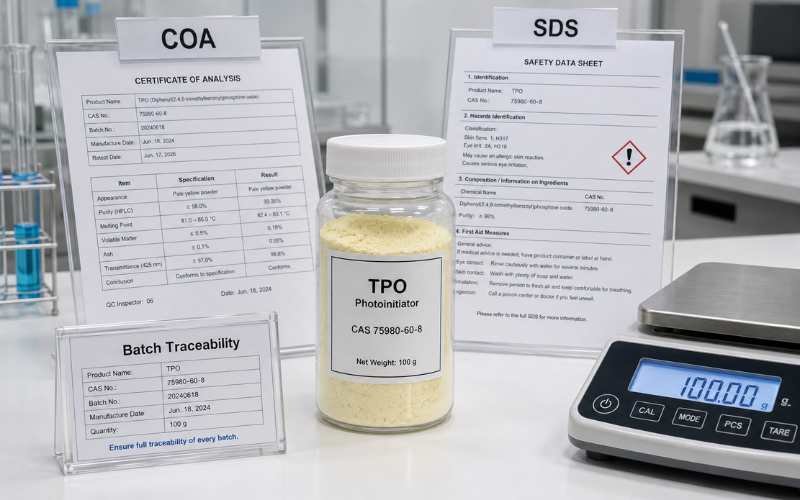
| Required documents | SDS, TDS, COA | Needed for approval, safety, and customs |
| Packaging | Export carton, drum, or customized packaging | Affects storage and logistics |
| Storage | Dry, sealed, protected from heat and light | Helps prevent quality loss |
The SONGWON photoinitiator leaflet identifies 819 as a BAPO photoinitiator used in coatings and inks, including pigmented applications.
My field note: I do not approve a new 819 supplier based on purity alone. I check whether the second and third batch can match the first sample. Many production problems start after the lab approval, not before it.
BAPO 819 Selection by Wavelength, Film Thickness, and Pigment Load
BAPO 819 works best when its absorption behavior matches the curing equipment and formula design.
| Factor | Lower-Risk Condition | Higher-Risk Condition | Role of BAPO 819 |
|---|---|---|---|
| Wavelength | Broad mercury UV lamp | Narrow UV-LED at 385, 395, or 405 nm | Helps when absorption matches LED output |
| Film thickness | Thin clear coating | Thick coating, adhesive, or resin layer | Supports through cure |
| Pigment load | Clear or light color | White, black, opaque, or filled system | Improves bottom-layer cure |
| Oxygen exposure | Low oxygen contact | Open surface with air exposure | May need blend support |
| Resin system | Fast-reactive acrylate | Slow or highly filled formula | Can improve cure but needs dosage tuning |
| Line speed | Slow and stable | Fast industrial production | Must be tested under real speed |
| Substrate | Transparent substrate | UV-blocking or reflective substrate | Cure depth becomes more critical |
The key is not only absorption. The whole system matters.
A 395 nm LED lamp, a white pigment package, and a thick coating film create a very different curing condition from a thin clear varnish under a mercury lamp.
For UV-LED projects, I suggest checking technical references from RadTech UV curing resources and photoinitiator supplier literature such as IGM Resins photoinitiator information, then validating performance in your own line.
Where Is BAPO Photoinitiator 819 Used?
BAPO 819 for UV Coatings
BAPO 819 is often selected for UV coatings where film thickness, color, or opacity makes curing difficult.
Common applications include:
- White UV coatings
- Pigmented wood coatings
- Plastic UV coatings
- Metal UV coatings
- Thick clear coatings
- UV powder coatings
- UV-LED coating systems
The old Ciba guide on photoinitiators for UV curing describes 819-type BAPO products as suitable for white coatings and thick clear coatings. This fits real production logic.
In UV coatings, surface cure can mislead buyers. A coating may feel dry, but the lower layer may remain soft. That causes weak adhesion, poor scratch resistance, and customer complaints after shipment.
For UV coating trials, test:
- Surface tack
- Bottom cure
- Pencil hardness
- Adhesion
- MEK rub resistance
- Yellowing
- Gloss retention
- Storage stability
- Line-speed tolerance
If your system is clear and thin, Photoinitiator 184 or Photoinitiator 1173 may be enough. If your system is white, thick, or pigmented, BAPO 819 deserves early testing.
My field note: In white UV coating trials, I check bottom cure before I check final gloss. A beautiful surface means little if the coating fails adhesion after cutting or stacking.
BAPO 819 for UV Inks
UV inks are harder than many coatings because pigments block and scatter light. White, black, and dense color inks create serious cure-depth problems.
BAPO 819 can help in:
- White UV inks
- Screen printing UV inks
- Flexo UV inks
- Offset UV inks
- Inkjet UV inks
- Dense color UV systems
- UV-LED ink lines
For UV ink factories, I recommend testing BAPO 819 when the ink shows:
- Poor through cure
- Weak rub resistance
- Soft lower film
- Poor adhesion after print
- Slow cure under LED
- Cure failure in white or opaque colors
Still, 819 may not solve every ink problem. If the surface remains tacky but the bottom is cured, the formula may need surface-cure support instead of more BAPO.
This is where ITX, DETX, 907, amine synergists, or blend design may matter. UVIXE’s ITX vs DETX photoinitiator guide can help buyers understand thioxanthone-type systems before comparing them with BAPO.
For food packaging inks, be careful. Do not assume BAPO 819 is approved for your final use. Review SDS, migration requirements, customer specifications, and local regulations before commercial use.
BAPO 819 for UV Adhesives
BAPO 819 can support UV adhesives when cure depth matters more than surface speed.
It may be useful in:
- Acrylic UV adhesives
- Glass bonding adhesives
- Plastic bonding adhesives
- Optical bonding materials
- Industrial assembly adhesives
- Electronics-related UV adhesives
Adhesives create a special challenge. The bond line may be thick. One substrate may block UV light. The adhesive may cure near the edge but remain weak in the center.
For adhesive buyers, test:
- Cure depth
- Bond-line thickness
- Lap shear strength
- Substrate transmission
- Yellowing after aging
- Shrinkage
- Final hardness
- Long-term adhesion
A thin clear adhesive may not need 819. A thicker or semi-opaque adhesive often does.
My field note: In UV adhesive trials, I ask for substrate details before photoinitiator dosage. Glass, PET, PC, acrylic, and coated metal do not transmit light the same way. The wrong substrate assumption leads to wrong PI selection.
BAPO 819 for SLA and DLP 3D Printing Resin
BAPO 819 is widely tested in SLA, DLP, and LCD 3D printing resin, especially when the system uses UV-A or near-visible LED curing.
It can support:
- SLA resin
- DLP resin
- LCD resin
- Pigmented 3D printing resin
- Filled engineering resin
- Opaque resin
- Dental or specialty resin after compliance review
For 3D printing material companies, 819 must be balanced carefully. More photoinitiator can increase cure depth, but excessive cure depth may reduce resolution.
Test these points:
- Exposure time
- Cure depth
- XY resolution
- Green strength
- Final hardness
- Pigment stability
- Post-cure behavior
- Yellowing
- Shelf stability
In 3D resin, fast cure is not the only target. A resin that cures too deeply can blur details, close small holes, or damage dimensional accuracy.
My field note: For 405 nm resin, I do not increase BAPO 819 blindly. I tune it with absorbers, pigment, exposure settings, and target layer height. A beautiful cure-speed number can hide poor print precision.
BAPO 819 vs TPO, TPO-L, 184, 1173, ITX, DETX, 907, and 369
A good photoinitiator choice is not about which product is famous. It is about which curing problem you need to solve.
| Photoinitiator | Main Strength | Best-Fit Applications | Buyer Warning |
|---|---|---|---|
| BAPO 819 | Deep cure and pigmented-system cure | White coatings, opaque inks, 3D resin, UV-LED systems | May need blend support for surface cure |
| TPO | Fast UV-A cure and good color balance | Clear coatings, inks, adhesives | May not be enough for very thick pigmented systems |
| TPO-L | Liquid handling and lower yellowing | Liquid blends, coatings, inks | Often weaker than BAPO for deep cure |
| 184 | Clean cure in clear systems | Clear coatings, varnishes, adhesives | Weak alone in opaque or thick systems |
| 1173 | Liquid and easy blending | Clear coatings and simple UV systems | Limited through-cure ability |
| ITX | Sensitization support | UV inks and pigmented systems | Type II system; requires co-initiator logic |
| DETX | Sensitizer in ink systems | UV inks and certain coating blends | Formula-specific testing required |
| 907 | Pigmented ink support | UV inks and coating blends | Odor and compliance review needed |
| 369 | Strong cure in pigmented systems | Thick inks and pigmented coatings | Color and regulatory review required |
If your team compares TPO and TPO-L for UV-LED or low-yellowing systems, read the UVIXE TPO vs TPO-L photoinitiator guide.
My practical selection logic:
- Use BAPO 819 when the main issue is deep cure.
- Use TPO or TPO-L when speed, UV-A response, and color balance matter.
- Use 184 or 1173 for clear, thin, less demanding systems.
- Use ITX or DETX when sensitization support is required.
- Use 907 or 369 only after odor, color, and compliance review.
Practical BAPO 819 Dosage Testing Matrix
Final dosage must be validated in your own resin, pigment, lamp, and film conditions. The table below is a practical starting point, not a fixed formula.
| Application | Starting Test Range | Main Test Focus | Adjustment Logic |
|---|---|---|---|
| Clear UV coating | 0.5–2.0% | Yellowing, hardness, surface tack | Reduce if yellow tone appears |
| Pigmented UV coating | 1.0–4.0% | Bottom cure, adhesion, hardness | Increase if lower layer remains soft |
| White UV ink | 2.0–5.0% | Through cure, rub resistance | Blend if surface remains tacky |
| UV adhesive | 0.5–3.0% | Bond strength and cure depth | Match dosage to bond-line thickness |
| SLA/DLP resin | 0.2–2.0% | Cure depth and resolution | Reduce if over-cure damages detail |
A serious trial should include three stages.
Stage 1: Dosage Screening
Test low, medium, and high BAPO 819 levels. Do not start with only one dosage.
Stage 2: Blend Screening
Test BAPO 819 with other photoinitiators if needed. Common blend candidates include TPO, TPO-L, 184, 1173, 907, ITX, DETX, and amine synergists.
Stage 3: Production Confirmation
Test under real line speed, real lamp age, real film thickness, real pigment batch, and real substrate.
Many lab approvals fail because the production line is harsher than the lab box.
Mini Scenario: White UV Coating Under-Cure
A white UV coating looks dry after curing, but adhesion fails after cross-cut testing. The surface is acceptable, but the bottom layer is weak.
Likely Cause
White pigment blocks light penetration. The original photoinitiator package cures the surface faster than the lower layer.
Test Plan
| Trial | Photoinitiator Direction | What To Check |
|---|---|---|
| A | Current formula | Baseline hardness and adhesion |
| B | Add BAPO 819 | Bottom cure improvement |
| C | BAPO 819 + surface-cure support | Surface tack and through cure |
| D | Adjust line speed or lamp intensity | Process sensitivity |
Decision Logic
If bottom cure improves without unacceptable yellowing or cost increase, BAPO 819 is justified. If only surface tack remains, the next change should focus on oxygen inhibition, not more BAPO.
This is the difference between technical buying and price buying.
Cost and TCO: Why Cheap BAPO 819 Can Become Expensive
Procurement teams often ask for the lowest price first. I understand why. But with BAPO 819, the cheapest quotation may not create the lowest total cost.
| Cost Factor | Price-Only Buying Risk | Technical Buying Standard |
|---|---|---|
| Incoming QC | More retesting and delays | Stable COA and clear acceptance range |
| Batch consistency | Cure speed changes between batches | Batch traceability and repeat supply |
| Reformulation | More lab time after failure | Side-by-side test before bulk order |
| Production downtime | Line stoppage from cure failure | Confirmed lead time and stock plan |
| Customer approval | Rejected trial or delayed launch | Documents ready before submission |
| Customs | Missing SDS, COA, or packing details | Complete export document support |
| Storage | Poor packaging and quality loss | Sealed, dry, export-grade packaging |
A small price saving disappears quickly if the material causes one failed customer trial or production delay.
For distributors, batch consistency is even more important. Your customer may accept the first sample, but they will judge you on the second, third, and fourth shipment.
Procurement Checklist for BAPO Photoinitiator 819
Use this checklist before placing a bulk order.
| Procurement Item | What To Ask Supplier | Why It Matters |
|---|---|---|
| Substance identity | CAS 162881-26-7 and chemical name | Avoids wrong material |
| Technical documents | SDS, TDS, COA | Supports approval and import |
| Sample | Lab sample before bulk order | Reduces formulation risk |
| COA control | COA for each batch | Helps incoming QC |
| Packaging | Net weight, carton, drum, pallet details | Supports warehouse planning |
| MOQ | Sample MOQ and bulk MOQ | Helps trial and scale-up planning |
| Lead time | Stock status and production schedule | Prevents line stoppage |
| Export support | Invoice, packing list, shipping documents | Helps customs clearance |
| Product range | 1173, 184, TPO, TPO-L, ITX, DETX, 907, 369 | Supports complete formulation sourcing |
At UVIXE, I prefer to quote after I understand the application. That is not a delay tactic. It prevents wrong matching.
A UV coating factory, UV ink factory, adhesive producer, 3D resin company, and distributor do not need the same answer.
Safety, Handling, and Compliance Review
BAPO 819 should be handled as an industrial chemical, not as a harmless powder.
Before purchase and use, review:
- SDS hazard classification
- PPE requirements
- Ventilation
- Dust control
- Storage temperature
- Light protection
- Local chemical inventory requirements
- Waste disposal rules
- End-market restrictions
For safety data, buyers can review supplier SDS documents and independent chemical references such as TCI chemical safety information. Always use the SDS from your actual supplier for final approval because classification and document format may vary by region and supplier.
For food packaging, toy, medical-related, dental, or electronics applications, do not rely on general photoinitiator claims. Ask your customer what standard they require, then test and document accordingly.
Common Buyer Mistakes When Sourcing BAPO 819
Mistake 1: Asking Only for “Best Price”
A low price does not solve cure failure. Ask for documents, sample support, COA consistency, and export lead time.
Mistake 2: Using 819 to Fix Surface Tack Only
Surface tack may come from oxygen inhibition. More BAPO 819 may not help. You may need blend support or process changes.
Mistake 3: Ignoring Pigment Type
White, black, and dense color pigments behave differently. Pigments absorb, scatter, and block light. Test by color system, not only by resin type.
Mistake 4: Forgetting Lamp Wavelength
A formula that works under mercury UV may not work under 395 nm or 405 nm LED. Match photoinitiator selection with lamp output.
Mistake 5: Approving a Sample Without Locking Bulk Standards
Do not approve only the lab sample. Agree on COA format, appearance, packaging, batch traceability, and lead time before bulk orders.
Mistake 6: Treating Irgacure 819 Equivalent as Automatic Approval
An equivalent material can work, but it must be tested. Compare cure speed, yellowing, odor, storage stability, and final application performance.
How I Would Select BAPO 819 for Different Buyers
For UV Coating Factories
I would test BAPO 819 first in pigmented, white, thick, or LED-curing coatings. For clear thin coatings, I would compare it with 184, 1173, TPO, or TPO-L before adding cost.
For UV Ink Factories
I would test BAPO 819 in white, black, and dense-color inks. I would also check whether the failure is through cure or surface tack. These require different fixes.
For UV Adhesive Producers
I would focus on bond-line thickness, substrate light transmission, and final strength. The best photoinitiator choice depends on how much light reaches the adhesive.
For SLA and DLP Resin Manufacturers
I would match BAPO 819 with printer wavelength first. Then I would tune dosage with absorber, pigment, layer height, and exposure time.
For Distributors and Traders
I would check supplier stability before price. A distributor needs repeat batches, fast documents, clear MOQ, export packaging, and a full photoinitiator portfolio.
BAPO 819 Buyer Decision Table
| Buyer Situation | Is BAPO 819 a Good Choice? | Decision Note |
|---|---|---|
| Clear thin UV varnish | Maybe | Lower-cost PI may be enough |
| White UV coating | Yes | Strong candidate for bottom cure |
| Black UV ink | Yes | Test through cure and rub resistance |
| Thick UV adhesive | Yes | Bond-line cure depth matters |
| 405 nm 3D resin | Yes, test carefully | Balance cure depth and resolution |
| Food packaging ink | Only after compliance review | Migration and customer approval required |
| Surface tack only | Not always | Check oxygen inhibition first |
| Distributor inventory | Yes, if supply is stable | COA, SDS, TDS, MOQ, and lead time matter |
This table is the core buying logic.
Do not ask only, “Is BAPO 819 good?” Ask, “Is BAPO 819 necessary for this curing problem?”
FAQ About BAPO Photoinitiator 819
Is BAPO the same as Photoinitiator 819?
Yes. In industrial UV curing, BAPO commonly refers to Photoinitiator 819, a bisacylphosphine oxide Type I photoinitiator used for deep curing.
What is the CAS number of BAPO Photoinitiator 819?
The CAS number of BAPO Photoinitiator 819 is 162881-26-7. Buyers should verify this number on SDS, TDS, COA, and import documents.
What is BAPO 819 used for?
BAPO 819 is used in UV coatings, UV inks, UV adhesives, UV resins, SLA resin, DLP resin, LCD resin, pigmented UV systems, white inks, and UV-LED curing systems.
Is BAPO 819 suitable for UV-LED curing?
Yes, BAPO 819 is often used in UV-LED formulations, especially when the wavelength and formula design match. Final performance depends on LED wavelength, intensity, pigment load, resin chemistry, and film thickness.
Can BAPO 819 work at 395 nm or 405 nm?
BAPO 819 can be tested in 395 nm and 405 nm UV-LED systems. However, buyers must validate exposure speed, cure depth, yellowing, and final properties in their own formulation.
Is BAPO 819 better than TPO?
BAPO 819 is often better for deep cure and pigmented systems. TPO may be better for fast curing in clear or lightly pigmented systems. The best choice depends on the application.
Is BAPO 819 better than 184?
BAPO 819 is stronger for deep curing and pigmented UV systems. Photoinitiator 184 is often better for clear, thin, low-yellowing coatings where deep cure is not difficult.
Can BAPO 819 replace Irgacure 819 or Omnirad 819?
BAPO 819 can be evaluated as an equivalent, but buyers must test it before replacement. Compare cure speed, color, odor, storage stability, COA, and final product performance.
Does BAPO 819 cause yellowing?
BAPO 819 is generally used where low yellowing is important, but yellowing still depends on dosage, resin, pigment, lamp, film thickness, and aging conditions. Always test in the final formula.
What is the typical dosage of BAPO 819?
Typical test ranges may run from about 0.2% to 5.0%, depending on application. Clear coatings may need less. White inks, pigmented coatings, and thick systems may need more.
Is BAPO 819 suitable for white UV ink?
Yes, BAPO 819 is commonly tested in white UV ink because white pigment blocks UV penetration. It may need blend support if surface tack remains.
Is BAPO 819 suitable for food packaging ink?
Do not assume suitability. Food packaging requires migration testing, customer approval, and regulatory review. Always check SDS and final end-use requirements.
How should BAPO 819 be stored?
Store BAPO 819 in a sealed container, away from heat, moisture, and direct light. Follow the supplier SDS and TDS storage instructions.
What documents should I request before importing BAPO 819?
Request SDS, TDS, COA, invoice, packing list, packaging details, storage guidance, and any documents needed for your local import process.
What should distributors check before buying BAPO 819 from China?
Distributors should check supplier batch stability, MOQ, lead time, export packaging, COA format, SDS availability, sample support, and full product range.
Can UVIXE supply BAPO 819 with technical documents?
Yes. UVIXE supplies BAPO Photoinitiator 819 with SDS, TDS, COA, sample support, export packaging, and sourcing support for B2B buyers.
The Practical Takeaway for Serious UV Buyers
BAPO Photoinitiator 819 is a deep-cure Type I photoinitiator for demanding UV curing systems. It is most useful when your formula faces pigment shielding, thick-film cure failure, UV-LED conversion, or bottom-layer under-cure.
But 819 is not always the cheapest or simplest answer.
For clear thin systems, 184, 1173, TPO, or TPO-L may be enough. For surface tack, oxygen inhibition may be the real problem. For 3D resin, over-cure may damage detail. For food packaging, compliance may decide the formula before performance does.
The best buying decision combines technical testing and procurement control: wavelength, film thickness, pigment load, resin chemistry, COA stability, SDS review, lead time, and export support.
Talk to UVIXE Before You Lock the Formula
If you are developing, replacing, or sourcing BAPO 819, UVIXE can support your evaluation with sample supply, TDS, SDS, COA, export packaging, and side-by-side replacement testing.
Choose the right path for your application:
- UV coating factory: request BAPO 819 samples for white, pigmented, or thick coating trials.
- UV ink factory: ask for BAPO 819 evaluation support for white, black, or dense-color ink systems.
- UV adhesive manufacturer: test BAPO 819 for bond-line cure depth and substrate transmission.
- SLA/DLP resin producer: match BAPO 819 with 385 nm, 395 nm, or 405 nm printer systems.
- Distributor or trader: request MOQ, lead time, COA, SDS, TDS, and export packaging details.
Start with UVIXE BAPO Photoinitiator 819, or compare related materials such as Photoinitiator 1173, Photoinitiator 184, TPO, TPO-L, ITX, DETX, 907, and 369 before placing bulk orders.