
Quick Answer
1. Choose TPO when your system is clear, colorless, or cost-sensitive, and your end market is outside EU regulatory scope. Best for: clear varnishes, wood coatings, water-based UV, standard adhesives. Price: $12–20/kg FOB China.
2. Choose 819 (BAPO) when you need deep cure through pigment, thick-film penetration, or compliance headroom for European markets. Best for: white coatings, 3D printing resins, pigmented inks, EU-destined products. Price: $28–50/kg FOB China.
3. The one fact that changes the decision: TPO was added to the EU REACH SVHC Candidate List in June 2023 and recommended for Annex XIV Authorization in November 2025. 819 carries no equivalent designation as of April 2026. If your customer sells finished goods into Europe, this is no longer a chemistry question — it is a procurement risk question.
Introduction
You have a customer in Germany. They need a white pigmented UV topcoat — 80 µm, 395 nm LED line — and they want to know which photoinitiator you are quoting. You have both TPO and 819 in stock. One is cheaper. One is compliant. One will actually cure their coating to spec.
This is where most procurement decisions go wrong. I have seen factories default to TPO because it is familiar, and I have seen R&D teams assume 819 is a stronger version of TPO and swap it in at the same weight loading. Both decisions cost money. One of them, in 2025, is also becoming a compliance liability with a countdown on it.
What follows is the full technical comparison — molecular mechanism, real dosage numbers from our own formulation work at UVIXE, a decision matrix, a REACH timeline you cannot ignore, and honest failure modes that most supplier articles never mention. No datasheets. No filler.
What Is the Difference Between TPO and 819 Photoinitiator?
TPO releases one radical pair per photon. 819 releases up to two. That single structural difference changes cure speed, film depth, cost, and regulatory status simultaneously.
TPO — diphenyl(2,4,6-trimethylbenzoyl)phosphine oxide — is a mono-acylphosphine oxide (MAPO). One UV photon triggers one C–P bond cleavage: one trimethylbenzoyl radical, one diphenylphosphinoyl radical. Two reactive species. One initiation event per molecule.
819 — phenylbis(2,4,6-trimethylbenzoyl)phosphine oxide, also called BAPO, Omnirad 819, or Irgacure 819 — is a bis-acylphosphine oxide (BAPO). Photolysis runs in two steps. The first cleavage yields a benzoyl radical and a mono-acylphosphinoyl intermediate. That intermediate absorbs a second photon and cleaves again, releasing a second benzoyl radical. The result: up to four reactive species, two initiation events, and measurably higher cure efficiency per gram of photoinitiator consumed.
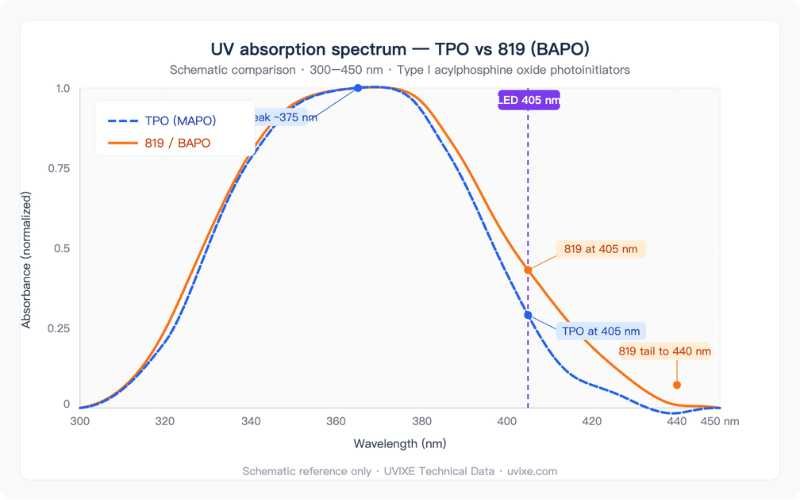
This is why, at equivalent weight loadings, absorbance and reactivity at 405 nm follows the confirmed order: 819 > TPO > TPO-L across all Type I phosphine oxides in controlled testing. Both photoinitiators share one critical advantage over older chemistry like 184 or 1173: their absorption spectra extend from 350 nm into the 420–440 nm range, making them the dominant photoinitiators for UV-LED sources at 365, 385, 395, and 405 nm — the wavelengths defining modern production lines in Europe, Japan, and increasingly Southeast Asia and India.
Technical Specifications: Side by Side
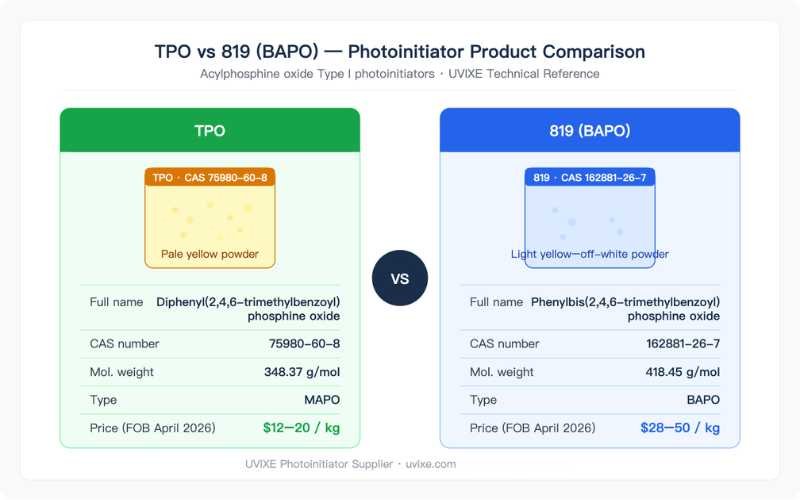
| Parameter | TPO | 819 (BAPO) |
|---|---|---|
| Chemical name | Diphenyl(2,4,6-trimethylbenzoyl)phosphine oxide | Phenylbis(2,4,6-trimethylbenzoyl)phosphine oxide |
| CAS number | 75980-60-8 | 162881-26-7 |
| PI type | MAPO — mono-acylphosphine oxide | BAPO — bis-acylphosphine oxide |
| Molecular weight | 348.37 g/mol | 418.45 g/mol |
| Primary absorption peak | ~370–380 nm | ~370–380 nm (tail extends to 440 nm) |
| 405 nm LED reactivity | High | Higher |
| Radical yield per molecule | 1–2 radicals | Up to 4 radicals (2-step photolysis) |
| Photobleaching effect | Yes | Yes — more pronounced |
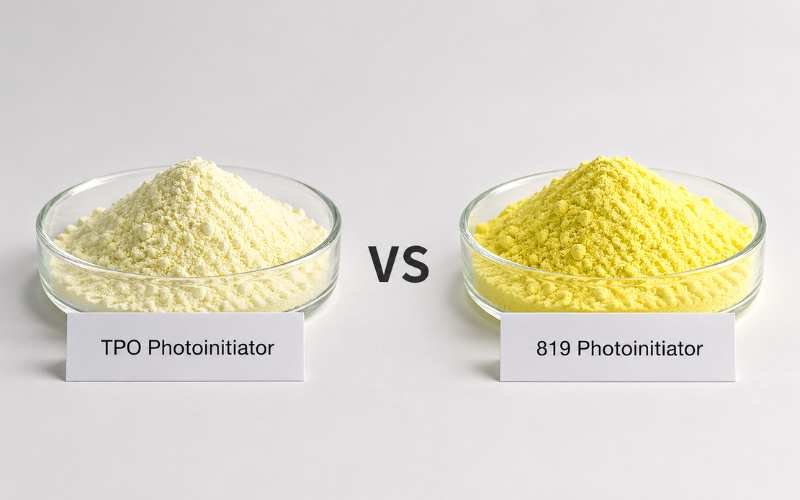
| Physical form | Pale yellow powder | Light yellow to off-white powder |
| Typical loading | 1–4 wt% | 0.5–3 wt% |
| Yellowing tendency | Low | Moderate–high in clear systems |
| Solubility in acrylate resins | Good | Good — crystallization risk above 3% |
| Water-based compatibility | Yes (low volatility) | Limited — dispersions available |
| Market price (April 2026, FOB China) | $12–20/kg | $28–50/kg |
| SVHC / REACH status | SVHC listed June 2023; Annex XIV recommended Nov 2025 | Not listed as of April 2026 |
| UVIXE MOQ | 25 kg | 25 kg |
| Lab sample available | Yes — 500 g minimum | Yes — 500 g minimum |
Performance Comparison — Where Each One Actually Wins
Cure Speed and Initiation Efficiency
At equivalent weight loadings, 819 initiates faster. This is not a claim — it follows directly from the dual-radical mechanism and higher molar extinction at 405 nm.
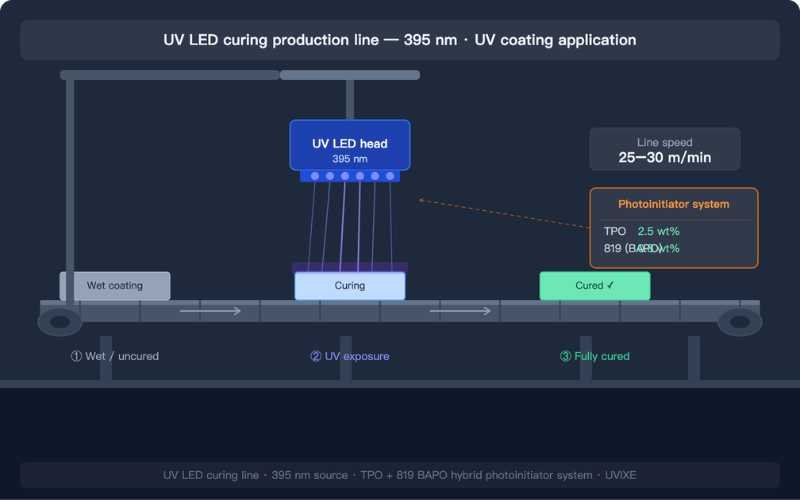
In our formulation lab at UVIXE, using a standard bisphenol A epoxy diacrylate / TPGDA (70:30) system at 2 wt% loading under a 395 nm LED at 200 mW/cm², 819 achieves tack-free surface cure in approximately 1 conveyor pass. TPO at the same loading requires 1.5–2 passes. On a production line running 25–30 m/min, that difference is throughput, energy cost, and line capacity.
The nuance most articles skip: because 819 has a higher molar initiation efficiency, you typically need 30–50% less 819 by weight to match TPO’s cure endpoint. That changes the real cost calculation — which I cover in the TCO section with actual numbers.
Thick Film and Deep Cure
819’s absorption tail extending toward 440 nm, combined with pronounced photobleaching, makes it the right choice for:
- UV coatings above 50 µm dry film thickness
- 3D printing resins where layer depth directly controls print resolution
- Optical fiber coatings requiring full through-cure at depth
- Thick adhesive layers and UV potting compounds
TPO photobleaches too — but less aggressively. In a 100 µm clear coat, TPO at standard loading can leave the substrate interface under-crosslinked. We have seen this cause adhesion failures on aluminum substrates in automotive interior coating trials. 819 at equivalent or lower loading consistently avoids this failure mode. The PMC-published photopolymerization study on Omnirad 819 confirms 819’s depth-cure advantage in films above 25 µm, while noting its surface cure in very thin films benefits from blending with a co-initiator such as 1173.
Pigmented and White Systems — Where 819 Earns Its Price
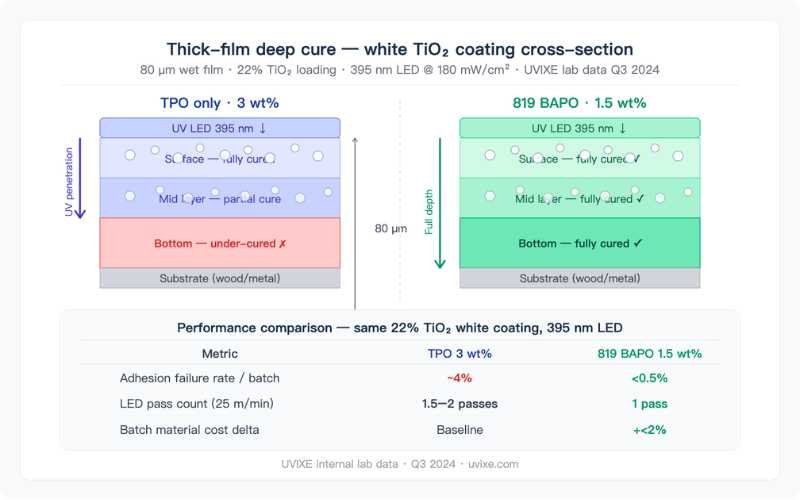
White coatings are where 819’s premium justifies itself clearly. Titanium dioxide scatters and blocks UV light — aggressively, especially below 380 nm. 819’s absorption tail at 420–440 nm sits above the primary TiO₂ scattering threshold, allowing photons to penetrate deeper into the film matrix.
In our own lab, we reformulated a 22% TiO₂ white wood panel coating in Q3 2024 — switching from a 3% TPO-only system to a 2% TPO + 0.8% 819 hybrid under a 395 nm LED at 180 mW/cm². Cure pass count on the line stayed identical. Substrate-interface adhesion failure rate dropped from ~4% per batch to under 0.5%. Batch material cost increased by less than 2%. That reformulation validated something I had suspected from earlier bench tests: in high-TiO₂ systems, the depth-cure contribution of 819 is not marginal — it is the difference between a line that runs reliably and one that generates rework.
LED vs. Mercury Lamp
Both photoinitiators work under both lamp types. Under mercury lamps — broad-spectrum, 254/313/365 nm emission — TPO performs well in thin films, particularly when combined with an amine synergist or a sensitizer such as ITX or DETX. Surface cure oxygen inhibition is the primary limiting factor under mercury, and both PIs respond well to amine co-initiators.
Under UV-LED sources (narrow-band, 365–405 nm), 819’s deeper long-wavelength absorption gives it a consistent edge. As European, Japanese, and increasingly Indian and Middle Eastern markets accelerate mercury-to-LED conversion — driven by RoHS, energy regulations, and lamp disposal costs — this distinction matters more every year. If your customer has converted to LED or is planning to, specify 819 or a TPO+819 blend for any pigmented or thick-film system.
Yellowing — The Differentiator That Ends Specifications
Let me be direct. If the end product must remain optically clear, 819 will cause measurable problems.
819’s photolysis produces more chromophoric byproducts than TPO. In clear varnishes, overprint lacquers, and optical adhesives, the ΔYI (yellowness index change) from 819 in a 25 µm clear coat typically runs 2–4× that of TPO at equivalent loadings. That is sufficient to fail colorimetric QC in furniture, automotive interior, electronics, and premium packaging applications.
TPO dominates clear wood coatings precisely because it combines low yellowing with good cure speed and cost efficiency. The photobleaching converts its yellow chromophore progressively during cure, leaving a visually clean film.
The rule I apply consistently: clear system = TPO (or TPO-L). Pigmented, white, thick film, or EU-compliance-critical = 819.
Application Decision Matrix
| Application | Recommended PI | Loading Range | Primary Reason |
|---|---|---|---|
| Clear UV varnish / lacquer | TPO | 2–4 wt% | Low yellowing, cost-efficient |
| White UV coating (TiO₂ >15%) | 819 or TPO+819 blend | 1–2.5 wt% 819 | Deep cure through pigment scattering |
| Colored UV ink (flexo/offset) | TPO+819 blend | 1.5 wt% TPO + 0.8 wt% 819 | Speed and pigment penetration |
| UV adhesive (clear, flexible) | TPO | 2–3 wt% | Color neutrality required |
| SLA / DLP 3D printing resin | 819 preferred | 0.1–0.3 wt% | Depth of cure controls layer resolution |
| Dental / medical UV resin | 819 (verify regional compliance) | 0.2–0.5 wt% | Depth cure + biocompatibility |
| Optical fiber coating | TPO or 819 | 1.5–3 wt% | Match cure equipment wavelength |
| UV inkjet (low-migration packaging) | 819 oligomeric grade | 0.5–1.5 wt% | Low migration, EU food-contact adjacent |
| Wood floor / furniture coat | TPO | 2–4 wt% | Clear, durable, non-yellowing |
| Water-based UV system | TPO or TPO-L | 1–3 wt% | Better aqueous dispersion behavior |
R&D teams and technical buyers: If your substrate, resin system, or cure equipment does not appear in this table, send UVIXE your specifications — we provide formulation guidance as part of our technical support, at no charge for qualified inquiries.
Dosage Optimization — Real Numbers, Not Datasheet Ranges
The most consistent mistake I see from new 819 buyers: treating it as a 1:1 weight substitute for TPO. It is not. Because 819 has a higher molecular weight (418 vs. 348 g/mol) and significantly higher molar initiation efficiency, you typically need 30–50% less 819 by weight to match TPO’s cure performance.
Over-loading 819 does three things, all of them bad: it increases yellowing, raises the risk of unreacted photoinitiator migration — a compliance concern in food-contact and skin-contact applications — and adds unnecessary formulation cost that procurement will question at the next price review.
Recommended Loading by Film Thickness and Lamp Type
| Film Thickness | Lamp Type | TPO Loading | 819 Loading | Notes |
|---|---|---|---|---|
| <20 µm (thin film) | LED 395/405 nm | 2–3 wt% | 0.5–1 wt% | Add amine synergist for surface cure |
| 20–50 µm | LED 395/405 nm | 2–4 wt% | 1–2 wt% | Standard coating range |
| 50–100 µm | LED 395/405 nm | 3–4 wt% | 1.5–2.5 wt% | 819 preferred for depth |
| >100 µm (thick film) | LED or Hg | 4 wt%+ (limited) | 2–3 wt% | 819 clearly superior |
| <50 µm | Mercury Hg lamp | 2–3 wt% | 1–1.5 wt% | Add ITX/DETX for surface |
| 3D printing layer 50–200 µm | 405 nm LED | 0.3–0.5 wt% | 0.1–0.3 wt% | Cure depth controls XY resolution |
For most standard 40–60 µm UV coating applications, the most cost-efficient starting point is not a pure 819 system. It is a 2.5 wt% TPO + 0.5 wt% 819 hybrid blend — TPO’s economy and low yellowing in the upper layers, 819’s depth contribution where the pigment or film thickness demands it. The blending logic, including failure modes, is in the next section.
The REACH / SVHC Problem — What TPO Buyers Cannot Ignore
Most supplier articles treat REACH as a footnote. It is not. For any buyer with customers in Europe — or customers whose customers are in Europe — this is now a supply chain decision with a countdown attached.
The TPO Regulatory Timeline
| Date | Event |
|---|---|
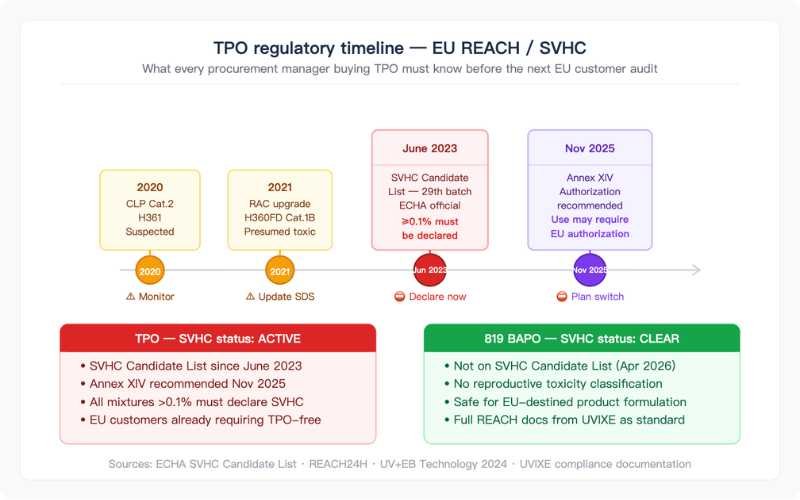
| 2020 | EU CLP classifies TPO as Category 2 reproductive toxicant — H361: “Suspected human reproductive toxicant” |
| 2021 | EU Risk Assessment Committee (RAC) agrees to upgrade to Category 1B — H360FD: “May damage fertility. May damage the unborn child” |
| June 2023 | ECHA officially adds TPO to the SVHC Candidate List, 29th batch. Annual EU consumption: 1,000–10,000 tonnes |
| November 2025 | ECHA recommends TPO for Annex XIV inclusion — the Authorization List — 12th recommendation batch |
| Next step | European Commission review. If added to Annex XIV, TPO use in the EU requires explicit authorization. Sunset dates will apply |
What This Means for Your Supply Chain Right Now
Any mixture containing ≥0.1 wt% TPO must already declare it as an SVHC in the SDS. Under REACH Article 33, you are required to inform downstream EU customers of its presence and provide safe-use information. This applies to Chinese exporters selling to European distributors or formulators — not just to companies operating inside the EU.
Many EU coating, ink, and adhesive buyers — particularly in Germany, the Netherlands, and Scandinavia — are already requesting TPO-free formulations as a procurement policy, regardless of where the legal authorization deadline lands. By the time a sunset date is set, their reformulation decision will already have been made. You want to be their alternative supplier before that happens, not after.
Is 819 affected? As of April 2026, 819 (BAPO) is not on the SVHC Candidate List and carries no equivalent reproductive toxicity classification. For buyers making procurement decisions with a 12–24 month planning horizon, 819 is the compliance-safer phosphine oxide choice for EU-destined products.
Procurement managers: UVIXE provides full REACH compliance documentation — SDS, batch CoA, SVHC declaration letters — for all photoinitiator shipments as standard. Contact us before your next EU customer audit.
REACH Compliance Checklist for TPO Buyers
- [ ] Confirm TPO content in any shipped mixture triggers the 0.1% SVHC declaration threshold
- [ ] Verify your current supplier’s SDS lists TPO as SVHC — this is now mandatory
- [ ] Notify downstream EU customers per REACH Article 33 obligations
- [ ] Assess whether your EU customers’ sector (food packaging, toys, cosmetics-adjacent) requires faster TPO phase-out than the authorization timeline implies
- [ ] Begin 819 or TPO-L qualification testing now — do not wait for a sunset date announcement to force a rushed reformulation
Total Cost of Ownership — The Calculation Most Buyers Get Wrong
Headline price: TPO is $12–20/kg. 819 is $28–50/kg. That looks like a 2–3× penalty. It is not, once you account for effective dosage and real-world loading requirements.
Cost Per m² of Coated Surface
Based on UVIXE FOB prices, April 2026. 40 µm wet film, 1.05 g/cm³ formulation density, standard UV wood coating application.
| Parameter | TPO System | 819 System |
|---|---|---|
| PI loading (wt%) | 3.0% | 1.5% |
| PI cost per kg (FOB April 2026) | $16/kg | $38/kg |
| PI cost per kg of formulation | $0.48 | $0.57 |
| Wet film weight per m² at 40 µm | ~42 g | ~42 g |
| PI cost per m² coated | ~$0.020 | ~$0.024 |
| Delta per m² | — | +$0.004 |
Less than half a US cent per square meter. Against the cost of a rejected batch, a reformulation project forced by regulatory deadline, or a lost European distribution contract requiring SVHC-free documentation, that $0.004/m² premium changes the calculation entirely.
Additional TCO Factors
- Lead time: Both TPO and 819 ship within 3–5 business days from UVIXE stock in Shandong for standard orders. For 500 kg+, allow 10–15 days production scheduling
- Packaging: 25 kg fiber drums or 200 kg drums. 819 requires light-exclusion packaging and storage below 25°C away from humidity — factor this into your warehousing cost
- MOQ: 25 kg for both from UVIXE. Lab samples at 500 g–1 kg for formulation qualification
- HS Code: Both fall under 2931.90 (other organo-phosphorus compounds). No current restricted cargo classification, though updated TPO SDS requirements may affect documentation in some EU ports
- Reformulation cost if TPO is restricted: Budget 4–8 weeks of R&D time plus QC re-validation for any production formula switch — this is the hidden cost most procurement models ignore entirely
Can You Blend TPO and 819? Yes — With One Important Caveat
A TPO + 819 hybrid is not a budget compromise. It is a deliberate formulation strategy that captures the strengths of both photoinitiators: TPO handles cost-efficient bulk initiation and surface clarity; 819 handles depth cure in pigment-blocked or thick-film zones. Together, they outperform either alone in mid-complexity pigmented applications — and cost less than a full 819 system.
RadTech research confirms that adding DETX as a thioxanthone sensitizer — the most efficient sensitizer for phosphine oxide systems at 404 nm — further improves surface cure under LED by sensitizing phosphine oxide cleavage and scavenging oxygen inhibition at the air-resin interface. This three-component system (TPO + 819 + DETX) is what we recommend for demanding pigmented coating applications under LED sources.
Recommended Blend Ratios
| Application | TPO | 819 | Sensitizer | Result |
|---|---|---|---|---|
| Pigmented UV coating, medium depth | 2.0 wt% | 0.8 wt% | — | Balanced cost and through-cure |
| White topcoat (TiO₂ ~20%) | 1.5 wt% | 1.5 wt% | 0.2 wt% DETX | Even initiation through pigment |
| 3D printing, standard resolution | 0.3 wt% | 0.15 wt% | — | Cost-optimized, consistent DOC |
| UV adhesive, thick section | 2.0 wt% | 1.0 wt% | — | Interface adhesion + through-cure |
| Colored UV flexo ink | 1.5 wt% | 0.8 wt% | 0.3 wt% ITX | Surface cure speed |
The Failure Mode You Need to Know
Here is what the blend guides do not tell you: adding DETX above 0.3 wt% in a TPO+819 blend for light-colored pigmented systems can cause visible surface yellowing.
DETX itself contributes chromophoric byproducts during sensitization. In a light beige or ivory pigmented coating, DETX at 0.35–0.4 wt% produced measurable ΔYI increases in our bench testing — enough to trigger a customer colorimeter QC failure at ΔYI >1.5. The fix was keeping DETX at or below 0.2 wt% and running a 24-hour aged yellowing test before approving the formula for production. In white or neutral-colored systems, always run the ΔYI colorimeter check on a cured panel before scaling. Do not assume the blend behaves the same as either photoinitiator used alone.
Frequently Asked Questions
Q: Is 819 a direct drop-in replacement for TPO at the same weight loading?
No. 819 has a higher molecular weight (418 vs. 348 g/mol) and significantly higher molar initiation efficiency. A 1:1 weight substitution will over-initiate, increase yellowing, raise unreacted PI migration risk, and add unnecessary cost. Start at 50% of your current TPO loading by weight and optimize from there with a tack test and ΔYI measurement.
Q: Can I still buy and sell TPO to European customers?
As of April 2026, TPO is on the SVHC Candidate List and recommended for Annex XIV, but not yet formally on the Authorization List. You can still sell it, but REACH Article 33 declaration obligations apply immediately for any mixture above 0.1% TPO. Many European buyers are already moving away from TPO by procurement policy — before any legal deadline. Start your 819 or TPO-L qualification now, not after a customer rejection.
Q: Where can I buy 819 photoinitiator with reliable quality and full REACH documentation?
UVIXE supplies 819 (BAPO) from Shandong, China with batch CoA, full SDS, and REACH compliance letters as standard on every order. MOQ is 25 kg. Lab samples from 500 g. Request a sample or quote at uvixe.com.
Q: What is the current price of TPO and 819 photoinitiator?
As of April 2026, UVIXE FOB China pricing is $12–20/kg for TPO and $28–50/kg for 819 depending on order volume and grade. Both prices reflect post-2022 supply normalization. Contact us for volume pricing on orders above 100 kg — we offer tiered pricing from 100 kg, 500 kg, and 1 MT+.
Q: Does 819 work in water-based UV systems?
Standard 819 powder has limited water compatibility. Water-dispersible 819 grades (819DW format) exist but are less widely available and carry a price premium. For water-based UV systems, TPO-L is generally the better fit — lower volatility, better aqueous dispersion behavior, and lower toxicity profile than TPO.
Q: What is the shelf life and storage requirement for each?
Both should be stored in sealed, light-proof containers below 25°C, away from humidity. Shelf life is 24 months under correct storage conditions. 819 has slightly better thermal stability than TPO but is more prone to crystallization in high-concentration acrylate solutions. Never store either product in direct light — even brief UV exposure triggers premature decomposition and loss of initiation efficiency.
Q: Which photoinitiator is better for SLA and DLP 3D printing?
819 is the industry standard for SLA and DLP resin systems. Its 405 nm LED compatibility, dual-radical mechanism, and photobleaching behavior allow loading as low as 0.1–0.3 wt%, which precisely controls cure depth for high-resolution prints. TPO works in 3D printing resins but requires slightly higher loading and produces less consistent cure depth in pigmented or particle-filled systems. For dental and biomedical resins, verify regional regulatory status of 819 before specifying.
The Decision, Simplified
TPO and 819 are not competitors. They are tools for different jobs — and increasingly, for different regulatory environments.
Choose TPO when the system is clear, yellowing tolerance is tight, and cost pressure is real. Manage the SVHC documentation proactively. Do not wait for your European customer to raise it first.
Choose 819 when you need depth, pigment tolerance, or compliance headroom. Run the TCO calculation before rejecting it on unit price — the per-m² cost gap is under half a cent at standard loadings.
Choose a blend for white or pigmented systems above 40 µm under LED. Use the ratios above. Keep DETX below 0.2 wt% in light-colored systems and always verify with a ΔYI colorimeter test before scaling.
The wrong move is a 500 kg purchase order based on a datasheet comparison and a price per kilogram. The right move is a 500 g sample, two weeks of formulation work, and a colorimeter reading on the cured panel.
Three Ways to Work With UVIXE
For R&D engineers and technical buyers:
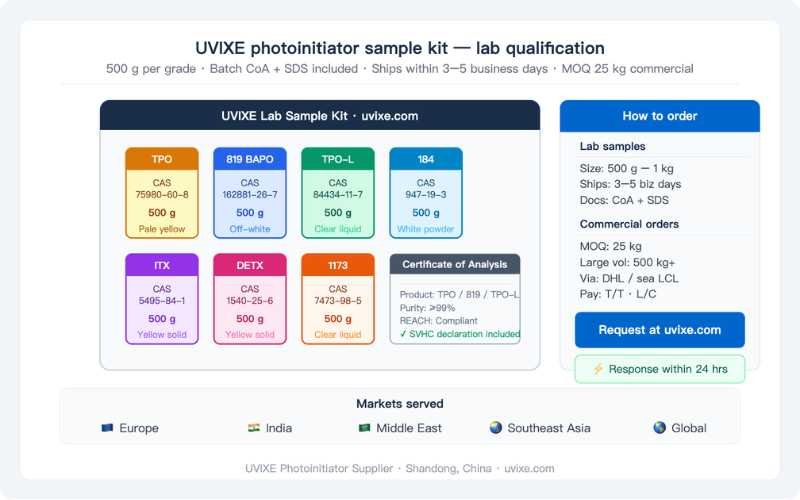
Test before you commit. UVIXE offers 500 g–1 kg lab samples of TPO, 819, TPO-L, ITX, DETX, 184, and 1173 for formulation qualification. We provide batch CoA and SDS with every sample. Request your lab sample here — shipped within 3–5 business days.
For procurement managers with EU customers:
If your customer is asking for SVHC-free documentation or a TPO compliance letter, we provide it as standard on every order. No extra charge, no waiting. Contact us before your next EU customer audit — response within 24 hours.
For distributors and traders:
UVIXE offers FOB tiered pricing from 100 kg, 500 kg, and 1 MT+ for all photoinitiator lines. Sea freight LCL/FCL from Qingdao or Shanghai. Payment by T/T or L/C. Ask about distributor pricing and lead time commitments — we work with trading companies across Europe, the Middle East, India, and Southeast Asia.