
Quick Answer
ITX (2-Isopropylthioxanthone, CAS 5495-84-1) and DETX (2,4-Diethylthioxanthone, CAS 82799-44-8) are both Norrish Type II thioxanthone photoinitiators used in UV-curable inks, coatings, and adhesives. Both require an amine co-initiator to generate radicals. Both function as sensitizers for Type I photoinitiators like TPO and 819. They are not interchangeable.
| Parameter | ITX | DETX |
|---|---|---|
| CAS Number | 5495-84-1 | 82799-44-8 |
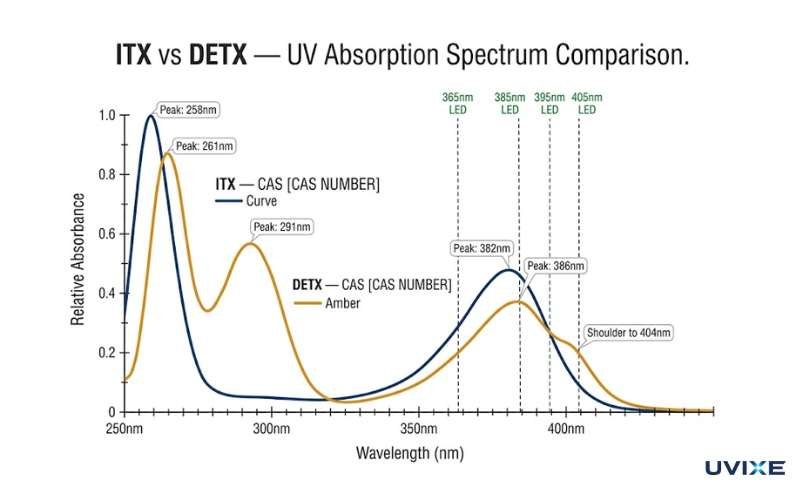
| Absorption Peaks | 258nm, 382nm | 261nm, 291nm, 386nm |
| LED Compatibility (395nm) | Low–Moderate | Good–High |
| Yellowing Risk | Moderate–High | Moderate |
| Food Packaging (EU) | ⚠️ Migration flagged 2005 | Lower risk — still verify |
| Optimal Lamp | Mercury (Hg) | UV-LED 385–405nm |
| Primary Application | Offset/screen ink, Hg coatings | LED ink, pigmented systems, wood |
Choose ITX when you run mercury lamps, work with Hg-optimized clear ink formulations, or operate outside food-adjacent packaging supply chains.
Choose DETX when your line runs UV-LED at 385–405nm, you work with pigmented inks, need better low-temperature solubility, or sell into European packaging markets with active migration compliance requirements.
The Problem Nobody Warns You About Before You Order
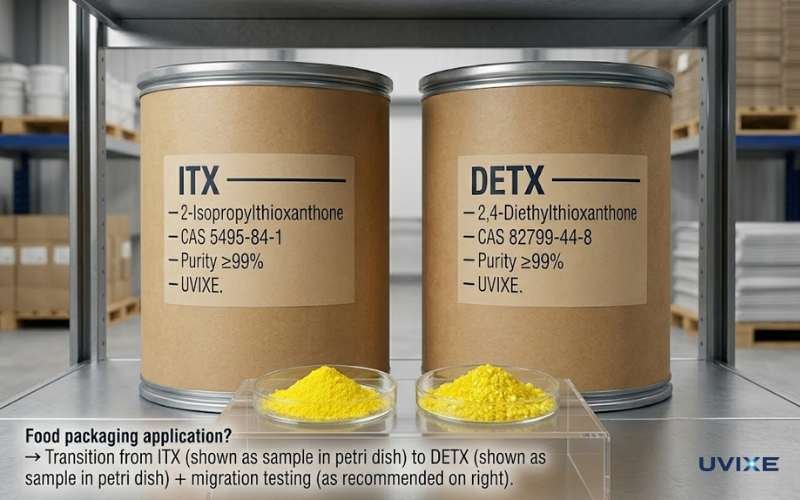
You’re sourcing a thioxanthone sensitizer. Your supplier’s product list shows ITX and DETX three rows apart. Same chemical family. Similar appearance. Comparable price. Both arrive as yellow powder in a 25kg drum.
You pick one. Three weeks later, your customer calls. The coating isn’t curing consistently. The ink is yellowing in a white substrate. Or — the scenario that ends supplier relationships — your European converter flags a compliance issue on a food-adjacent packaging line.
I’ve seen all three scenarios play out with buyers across India, Turkey, Germany, and Southeast Asia. Not because they were careless buyers. Because the difference between ITX and DETX is genuinely subtle on a product sheet and genuinely consequential in a production line.
At UVIXE, we supply both. I’m not here to push one over the other. What I’m here to do is give you the selection logic that most product sheets deliberately skip — so you order the right one the first time.
What Are ITX and DETX, and Why Does the Thioxanthone Family Matter?
Both molecules are Norrish Type II photoinitiators. Type II initiators do not fragment spontaneously under UV light. They absorb photons, reach an excited triplet state, then abstract a hydrogen atom from a co-initiator — typically a tertiary amine. That amine-derived radical initiates polymerization. The thioxanthone itself is regenerated in the process, which is why it is often described as a sensitizer rather than a consumed initiator.
This mechanism has two practical consequences you need to understand before formulating:
First: you always need an amine synergist. Without it, ITX and DETX contribute almost nothing to cure. The amine is not optional — it is the other half of the reaction.
Second: both molecules can sensitize Type I photoinitiators. They absorb UV at longer wavelengths than TPO or 819 (BAPO), then transfer that triplet energy to the Type I molecule, which then fragments and initiates polymerization. This is why DETX + TPO blends are now common in LED systems — you use the thioxanthone to capture wavelengths that TPO cannot absorb efficiently, then let TPO do the radical generation.
Research published via Radtech confirms that DETX is the most efficient thioxanthone sensitizer for phosphine oxides, specifically because of its stronger absorbance at 404nm — a wavelength where ITX underperforms.
Identity and Physical Properties
| Property | ITX | DETX |
|---|---|---|
| Chemical Name | 2-Isopropylthioxanthone | 2,4-Diethyl-9H-thioxanthen-9-one |
| Molecular Formula | C₁₆H₁₄OS | C₁₇H₁₆OS |
| Molecular Weight | 254.35 g/mol | 268.38 g/mol |
| Appearance | Yellowish powder | Yellow crystalline powder |
| Melting Point | 70–76°C | 92–96°C |
| Absorption Peaks | 258nm, 382nm | 261nm, 291nm, 386nm |
| Recommended Dosage | 0.2–2.0% | 0.1–5.0% |
| Co-initiator Required | Yes (amine) | Yes (amine) |
| CAS Number | 5495-84-1 | 82799-44-8 |
ITX vs DETX — The Core Technical Differences
The Absorption Spectrum: The Number That Decides Everything
ITX peaks at 382nm. DETX peaks at 386nm, with meaningful absorbance extending to 404nm. Four nanometers on a datasheet. A measurable cure efficiency gap on a 395nm LED line.
A deviation of just 20nm from a photoinitiator’s λmax can reduce absorption efficiency by 50% or more, which translates directly to slower cure kinetics, higher required irradiance, and incomplete polymerization in thick or pigmented films. ITX at 395nm is operating 13nm from its peak. DETX at 395nm is operating 9nm from its peak — and its 404nm shoulder means it still captures meaningful photon flux at 405nm, where ITX is largely inactive.
For buyers running mercury lamps, this gap is irrelevant. Mercury emission is broadband — it covers 254nm to 400nm and beyond. Both ITX and DETX absorb efficiently within that range, and performance differences at any single wavelength are smoothed out by the spectrum width.
For buyers installing new LED equipment — which describes the majority of capital investment decisions I see from European and Indian customers right now — this gap is the primary selection criterion.
Lamp-to-Photoinitiator Match:
| UV Source | Peak Output | ITX Fit | DETX Fit | Verdict |
|---|---|---|---|---|
| Mercury (Hg) Lamp | Broadband 254–400nm+ | ✅ High | ✅ High | Either works |
| UV-LED 365nm | 365nm | ✅ Moderate | ✅ Moderate | Slight ITX edge |
| UV-LED 385nm | 385nm | ⚠️ Moderate | ✅ Good | DETX preferred |
| UV-LED 395nm | 395nm | ⚠️ Low–Moderate | ✅ Good–High | DETX clearly better |
| UV-LED 405nm | 405nm | ❌ Low | ✅ High | DETX only |
Curing Performance in Pigmented vs. Clear Systems
All thioxanthones yellow. This is structural — the chromophore absorbs visible light and its photodegradation byproducts are colored. You cannot eliminate it. You manage it through dosage, co-initiator selection, and resin chemistry.
ITX yellowing tends to be more pronounced under mercury lamp conditions, particularly in high-UV-dose environments like multi-pass coating lines. In clear, white, or light-tinted formulations, I recommend keeping ITX below 0.8% and monitoring color shift after aging. Some customers who ignored this ceiling came back to me six months later asking why their clear topcoat had gone amber. The answer was always the same: too much ITX, too long under the lamp.
DETX shows moderate yellowing — better than ITX in most pigmented systems, comparable in clear. In highly pigmented offset or screen inks, the initiator’s color contribution is dominated by the pigment anyway, so the difference between ITX and DETX in a black or cyan ink is academically interesting but practically negligible. Where DETX’s advantage becomes real is in medium-pigmentation flexo inks and overprint varnishes — substrates where color shift actually reaches the customer’s eye.
One practical note from our production testing: DETX at 1.0% in a white UV wood coating caused visible yellowing within 72 hours of cure under accelerated aging. The same formulation with 0.5% DETX + 1.5% TPO showed significantly better color retention. The lesson — thioxanthone dosage in clear and white systems needs aggressive downward pressure, paired with a Type I initiator carrying the load.
Solubility and Cold-Weather Formulation Behavior
DETX dissolves more readily in common UV-reactive monomers — TPGDA, HDDA, IBOA, DPGDA — than ITX at equivalent temperatures. Its higher melting point (92–96°C vs. ITX’s 70–76°C) might suggest worse solubility, but in practice the diethyl substitution pattern improves its interaction with acrylate monomer systems.
ITX crystallizes at low temperatures. I’ve had customers in Finland and South Korea report that ITX drums received in winter had visibly crystallized product at the drum walls and bottom. The material is still usable — warm the drum to 35–40°C, mix thoroughly, verify dissolution — but in a production environment that runs three shifts, that extra step creates real scheduling friction.
If your facility operates below 15°C or your shipments transit cold-chain logistics in winter months, DETX is the lower-risk choice for formulation stability.
The Regulatory Red Flag — ITX and Food Packaging
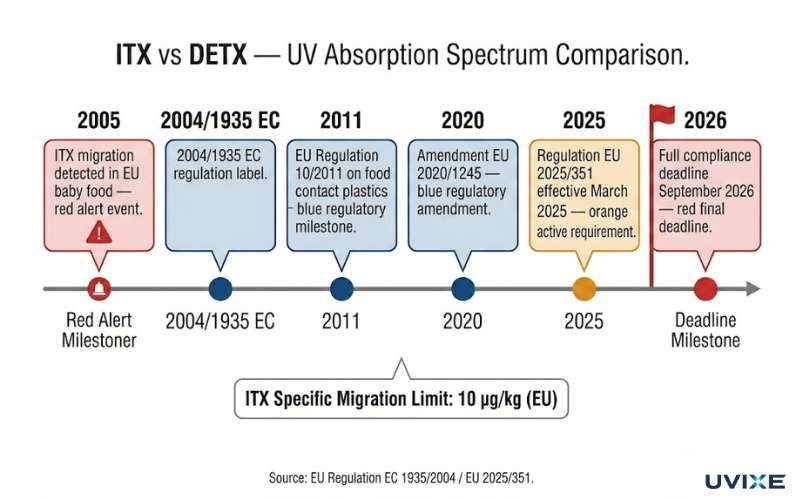
In autumn 2005, ITX was detected in baby food at concentrations up to 450 µg/kg across multiple European markets. The source was UV-cured offset printing ink on the outside of packaging cartons. ITX migrated through the packaging substrate — set-off migration — into the food contact layer. This was not a fringe incident. It triggered a market-wide reformulation across European UV ink producers.
The regulatory framework that governs this is EU Framework Regulation EC No. 1935/2004, which requires that food contact materials not release constituents at levels harmful to human health. For substances with insufficient toxicological data and molecular weight under 1,000 Daltons — ITX at 254 g/mol falls squarely here — the specific migration limit is 10 µg/kg, as confirmed by the Institut Kuhlmann migration testing framework.
The newer Regulation EU 2025/351, effective March 2025, tightens purity and migration testing requirements further. Full compliance deadlines extend to September 2026, but the obligation to test and document is active now.
What this means for your procurement decision:
If you supply UV inks, coatings, or adhesives to converters in the European food packaging supply chain, ITX should not be in your formulation. Not because it is banned categorically — it is not — but because its migration risk profile is documented, its regulatory history is damaging, and no European brand owner will accept it in a food-adjacent ink specification today.
DETX is not automatically exempt. Any photoinitiator with molecular weight under 1,000 Da can migrate. DETX (MW 268 g/mol) is in the same risk category by mass alone. The difference is that DETX does not carry ITX’s documented contamination history, and some formulators have validated DETX-based systems for specific food packaging applications. Validate with migration testing. Do not assume.
For non-food-contact industrial coatings, wood finishes, electronics, and UV adhesives outside food-adjacent applications — this entire section is less relevant. ITX remains excellent and cost-effective for those markets.
Amine Synergist Pairing — The Variable Most Buyers Underestimate
This is the formulation variable I see handled most carelessly by buyers switching between ITX and DETX. The amine is not a passive additive. It determines surface cure speed, oxygen inhibition resistance, and whether you get a tack-free surface or a sticky film.
The wrong amine at the wrong loading, for the wrong lamp, will undermine even a perfectly chosen thioxanthone.
Amine Synergist Pairing Guide:
| Amine | Common Name | Recommended Loading | Best With | Lamp Type | Key Characteristic |
|---|---|---|---|---|---|
| EDAB | Ethyl 4-dimethylaminobenzoate | 1.5–3.0% | ITX | Hg | Good surface cure, mild odor |
| EDB | Ethyl 4-dimethylaminobenzoate (liquid) | 2.0–4.0% | DETX | LED | Strong oxygen inhibition resistance |
| MDEA | Methyldiethanolamine | 2.0–4.0% | ITX or DETX | Hg | Good reactivity, water-compatible systems |
| DMEA | Dimethylethanolamine | 1.0–2.5% | DETX | LED | Fast surface cure, slight odor |
| Amine acrylate (CN3715 etc.) | Polymeric amine | 3.0–6.0% | DETX + TPO | LED | Low migration, excellent surface cure |
The LED-specific issue with amine selection: Under mercury lamps, the broadband emission excites the amine-thioxanthone complex across a wide spectral window. Under a monochromatic 395nm LED, the excitation is narrow. This means oxygen inhibition — the surface tack problem — is more acute under LED conditions because fewer photons are available to drive surface radical generation. Higher amine loading (3.0–4.0%) and/or polymeric amine co-initiators compensate for this. With ITX under 395nm LED, I’ve seen buyers use the same amine loading they used under mercury and wonder why their surface feels sticky after cure. The lamp changed. The formulation did not.
Which Lamp System Are You Running? (The Decision Framework)
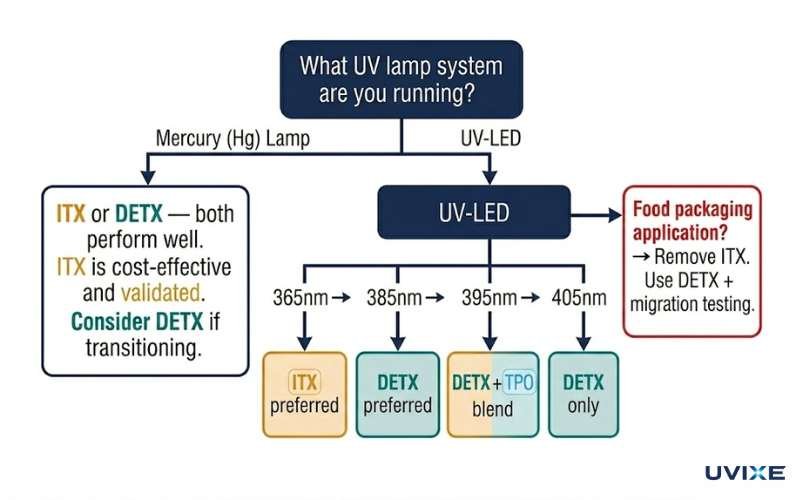
If you run mercury lamps: ITX is mature, well-validated, and cost-competitive. Decades of formulation data exist for ITX + amine systems under Hg conditions. Your existing TDS and cure profiles were likely built around ITX. Switching to DETX is possible — the performance will be comparable — but requires reformulation time with no guaranteed uplift in performance. Only switch if you are also changing other formulation variables.
If you run UV-LED at 385nm or above: DETX is the stronger choice. Pair it with TPO or TPO-L for depth cure and EDB or a polymeric amine for surface cure. The DETX + TPO energy transfer mechanism is more efficient at 395–405nm than the equivalent ITX + TPO blend.
If you are transitioning from Hg to LED: Do not swap ITX for DETX 1:1 and assume the system transfers. Rebuild the formulation. My standard starting point for customers mid-transition:
| Component | Role | Starting Loading |
|---|---|---|
| DETX | Sensitizer / Type II initiator | 0.5–1.0% |
| TPO or TPO-L | Type I initiator | 1.5–2.0% |
| EDB or polymeric amine | Co-initiator / surface cure | 2.5–4.0% |
| Amine acrylate (optional) | Oxygen inhibition resistance | 3.0–5.0% |
Run gel fraction testing at your production line speed before committing this to a customer formulation.
Application-by-Application Selection Guide
| Application | Lamp | Recommended PI | Co-initiator | Notes |
|---|---|---|---|---|
| Offset ink (pigmented) | Hg or LED | DETX | EDAB (Hg) / EDB (LED) | Better pigmented performance |
| Screen printing ink | Hg | ITX | EDAB | Established, cost-effective |
| Screen printing ink | LED | DETX | EDB | Better wavelength match at 395nm |
| Flexo ink (clear) | Hg | ITX | MDEA | Keep dosage ≤0.8%, monitor yellowing |
| Flexo ink (pigmented) | LED | DETX | EDB | Strong depth cure in pigmented layers |
| Wood coating (clear) | Hg | ITX | EDAB | Low dosage critical; use ≤0.5% |
| Wood coating (pigmented) | LED | DETX | EDB | DETX + TPO-L blend recommended |
| Overprint varnish | LED | DETX | EDB + amine acrylate | Surface cure critical; use polymeric amine |
| UV adhesive (non-food) | Either | Either | EDAB or EDB | Match to lamp; verify end-use contact |
| UV adhesive (food-adjacent) | Either | DETX + migration test | EDB | Document compliance; avoid ITX |
| Industrial coating | Either | Either | EDAB or EDB | Lamp is primary selection driver |
| Electronics encapsulant | LED | DETX | EDB | LED compatibility, low migration priority |
Common Mistakes I See When Buyers Switch Between ITX and DETX
These are real scenarios. Not hypotheticals.
Mistake 1 — Direct 1:1 substitution without amine adjustment.
A flexo ink producer in India switched from ITX to DETX mid-batch when ITX stock ran short. Same loading (1.2%). Same amine (EDAB at 2.0%). Same LED lamp at 395nm. Result: surface tack. The DETX was doing its job — the amine loading was insufficient for the LED environment. They needed EDB at 3.0–3.5% to compensate for oxygen inhibition under monochromatic LED. The photoinitiator was not the problem. The co-initiator ratio was.
Mistake 2 — Over-dosing DETX in clear coatings.
A wood coating manufacturer in Southeast Asia used DETX at 2.0% in a clear UV topcoat, migrating from a Hg line. Three weeks post-delivery, customer complaints about yellowing. DETX at 2.0% in a high-UV-exposure clear system is aggressive. The fix: 0.5% DETX + 1.5% TPO. The DETX sensitizes the TPO efficiently under LED; the TPO carries the initiation load with better color stability. Total thioxanthone dosage drops; color performance improves.
Mistake 3 — Using ITX in a food packaging ink after 2005.
A contract ink manufacturer in Turkey was running an ITX-based offset ink formulation for a flexible packaging customer. The end-use was snack food secondary packaging. Their European distributor flagged the ITX during a compliance audit. The entire batch was rejected. Lead time lost: 6 weeks for reformulation. Migration testing cost: additional 3–4 weeks and several thousand euros. The technical fix was straightforward — replace ITX with DETX and validate migration. The commercial cost of not having caught it earlier was not.
Mistake 4 — Ignoring cold storage for ITX in winter shipments.
A coating manufacturer in Finland received a 100kg ITX shipment in February. The drum sat in an unheated warehouse for 48 hours. Crystallized product at the base. They tried to use it without full dissolution and got inconsistent cure across the coating line — some areas undercured, some overcured depending on how the suspended crystals distributed through the batch. DETX in the same conditions showed no crystallization. In cold-climate facilities, this matters.
TCO & Procurement Reality — A Real Cost Model
DETX typically prices 5–15% higher than ITX at equivalent purity (≥99% HPLC). But the per-kilogram price is not the right number to compare. The right number is cost per unit of cured output.
Worked Example — 1,000 kg batch, pigmented LED ink:
| Parameter | ITX System | DETX System |
|---|---|---|
| PI dosage in formulation | 1.5% | 1.0% |
| PI required per 1,000kg batch | 15 kg | 10 kg |
| Assumed PI price (indicative) | $18/kg | $20/kg |
| PI cost per batch | $270 | $200 |
| Amine co-initiator (EDB at 3%) | $90 | $90 |
| Estimated cure passes needed (LED 395nm) | 2 passes | 1 pass |
| Energy cost differential | Higher | Lower |
| Total PI + amine cost per batch | $360 | $290 |
Prices are indicative only — contact UVIXE for current CIF pricing to your port.
The DETX system costs less per batch in this scenario — despite higher per-kg price — because the dosage is lower and the LED efficiency reduces the number of lamp passes required. This pattern is consistent across most LED-optimized DETX formulations I’ve seen. The per-kg premium is real. The per-batch premium often is not.
What to request from any supplier before ordering:
- Certificate of Analysis (COA): purity ≥99% by HPLC, melting point, absorption spectrum
- Technical Data Sheet (TDS): including recommended dosage range and co-initiator pairings
- Safety Data Sheet (SDS): with REACH registration status via ECHA
- REACH compliance letter for EU-destined shipments
- Migration test data if food-adjacent application is involved
- Sample batch (500g–1kg) for formulation validation before production order
Typical commercial terms from verified Chinese suppliers:
MOQ: 25kg (R&D) to 500kg (production). Lead time CIF: 15–25 days to European ports, 10–18 days to Indian ports, 12–20 days to Southeast Asia. Both ITX and DETX ship as non-hazardous under standard IMDG class — no special shipping surcharges.
My Formulation Recommendation as a Photoinitiator Supplier
Here is what I tell customers who call and ask “which one should I order” — based on the three variables that actually matter: lamp, substrate, and end market.
Scenario 1 — Mercury lamp, clear coating, non-food-contact:
Stay with ITX at 0.5–1.0% + EDAB at 2.0–3.0%. This is a proven system. Reformulating to DETX gives you no measurable advantage under Hg conditions and costs you formulation time. Only switch if you are planning a lamp upgrade.
Scenario 2 — 395nm LED line, pigmented offset or flexo ink:
DETX at 0.8–1.2% + EDB at 3.0–4.0% + TPO at 1.0–1.5%. The DETX sensitizes the TPO efficiently at 395nm. The EDB handles surface cure against oxygen inhibition. Run gel fraction tests at line speed before committing to production volumes.
Scenario 3 — European food packaging converter, any lamp:
Remove ITX. Use DETX at validated loading with migration test documentation. If your formulation needs more initiation power than DETX alone provides, pair with 819 (BAPO) — which has a different migration profile and broader regulatory acceptance in some food-adjacent applications. Document everything. Your European buyer will ask for it.
Scenario 4 — Transitioning from Hg to LED, existing ITX formulation:
Do not do a direct swap. Rebuild around DETX + TPO + polymeric amine. Plan for 2–4 weeks of formulation validation time. The lamp change is the bigger variable — the photoinitiator switch is secondary. Get the lamp output data first, then match the PI absorption profile to it.
FAQ
Q: Can I use ITX and DETX together in the same formulation?
Yes, and some formulators do this deliberately to broaden the absorption profile. The combined spectrum covers 382–404nm more uniformly than either molecule alone, which helps in systems where lamp output is not perfectly monochromatic or where multiple UV sources are in play. Typical combined loading: ITX at 0.3% + DETX at 0.5% + amine at 2.5–3.5%.
Q: My current ITX formulation works well under mercury lamps — do I need to switch for LED?
Not immediately. If you are not changing your lamp, your validated ITX system is fine. The switch to DETX becomes necessary when you install LED equipment at 385nm or above. Plan the reformulation before the lamp arrives, not after.
Q: What happens if I over-dose DETX in a clear coating?
Yellowing — visible within days to weeks under UV or daylight exposure, accelerated by heat. At 2.0% DETX in a clear system, expect detectable color shift after aging. The correction is to reduce DETX to 0.3–0.5% and supplement with TPO at 1.5–2.0%, which carries the initiation load with better color stability.
Q: Can I use DETX in a water-based UV system?
DETX has limited water solubility. For water-based UV formulations, you need either a pre-dispersed photoinitiator emulsion or a water-dispersible amine co-initiator. Using standard DETX powder directly in a water-based system will give you poor dissolution, inconsistent initiation, and formulation instability. This is a common error from buyers moving from solvent-based to water-based systems.
Q: Is DETX REACH compliant for EU shipments?
DETX (CAS 82799-44-8) is registered under REACH via ECHA. Always request the current SDS with REACH registration confirmation from your supplier. For food-adjacent applications, REACH compliance is necessary but not sufficient — you also need migration testing data specific to your formulation and application.
Q: What amine synergist ratio do I use with DETX under a 395nm LED?
Start at EDB 3.0–3.5% for standard pigmented inks. Increase to 4.0% if surface tack persists. For clear systems with low DETX loading (≤0.5%), a polymeric amine co-initiator at 4.0–5.0% gives better surface cure without introducing migration risk from low-MW amine fragments.
What the ITX-to-DETX Transition Tells You About Where the Industry Is Going
The growing preference for DETX in new formulations tracks directly with UV-LED adoption. LED curing now delivers 30–70% energy savings versus mercury, with operational lifetimes exceeding 20,000–30,000 hours. New equipment installations in European, Indian, and Southeast Asian printing and coating facilities are predominantly LED. ITX was designed for a mercury-lamp world. DETX fits the LED world better.
That does not make ITX obsolete. It means ITX has a defined lifecycle tied to mercury lamp infrastructure — and mercury lamp infrastructure is being replaced on a predictable schedule. If your facility has a 5–10 year capital plan that includes lamp upgrades, your photoinitiator strategy should reflect that timeline.
At UVIXE, new DETX orders currently outpace ITX orders from LED-equipped customers by a growing margin. The curve is not reversing. For buyers who are specifying a photoinitiator for new production capacity — not maintaining existing lines — DETX is the forward-compatible choice.
The Bottom Line on ITX vs DETX
Mercury lamp + clear system + non-food-contact → ITX.
LED 395nm + pigmented ink + EU buyer → DETX.
Transition period or mixed equipment → Run both. Validate both. Document both.
The selection is not complex once you have three data points: your lamp type, your substrate, and your end market. Every other variable — dosage, amine pairing, sensitizer blending — follows from those three.
What this decision should never be: a purchasing default based on whichever product is cheaper this month, or whichever one your previous supplier always sent.
Let’s Get Your Formulation Right Before You Place the Order
At UVIXE, we supply both ITX (CAS 5495-84-1) and DETX (CAS 82799-44-8) at ≥99% purity. Every shipment includes COA, TDS, SDS, and REACH documentation. No exceptions.
If you are reformulating for LED, scaling a new ink line, validating a food-packaging-compliant system, or simply evaluating a supplier switch — send us your current setup: lamp type, resin system, substrate, target application, and destination market. We’ll give you a specific starting-point recommendation and a sample batch to validate it against your line conditions.
Sample requests: 500g–1kg. Dispatch within 3–5 business days.
Production orders: 25kg–500kg. CIF pricing available for Europe, India, Middle East, and Southeast Asia.
Also available: 1173 · 184 · TPO · TPO-L · 819 (BAPO)
Contact the UVIXE technical team → uvixe.com