
Quick Answer
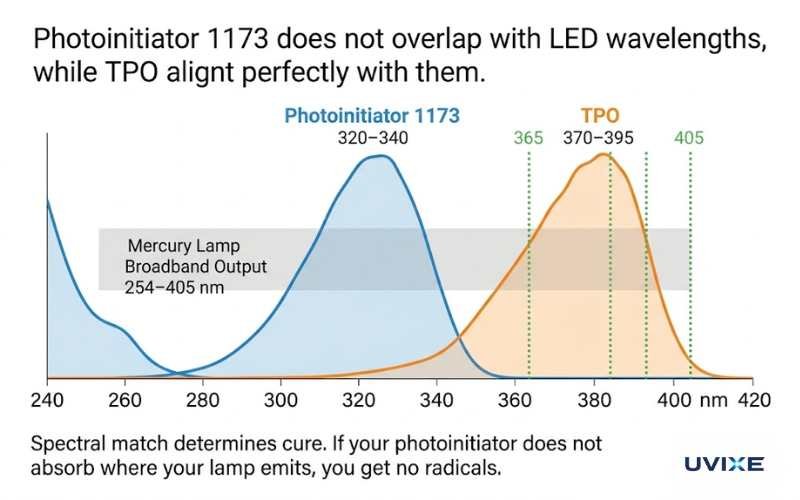
- For mercury (Hg) lamp systems: Photoinitiator 1173 absorbs at 320–340 nm and matches mercury lamp output directly. It is your cost-effective primary initiator.
- For UV LED systems (365–405 nm): TPO absorbs at 370–395 nm, where LED arrays actually emit. It is the only viable primary initiator for LED lines.
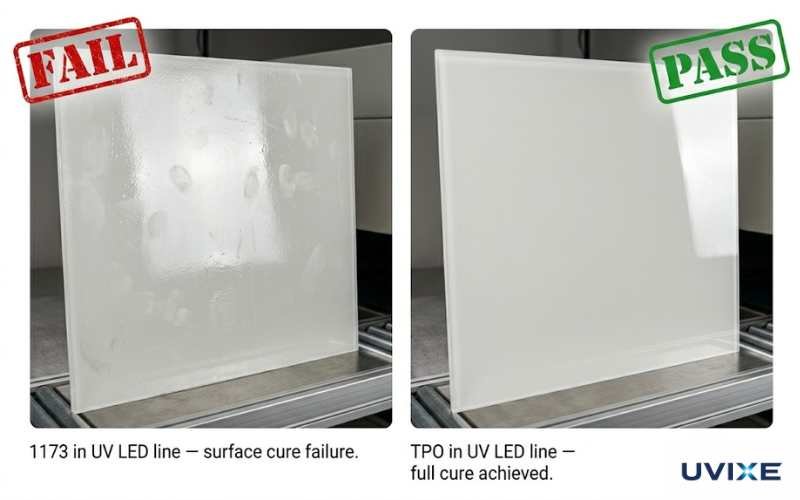
- Using 1173 in a UV LED line produces no usable radicals. Your light source and your photoinitiator absorption window must overlap — or cure does not happen.
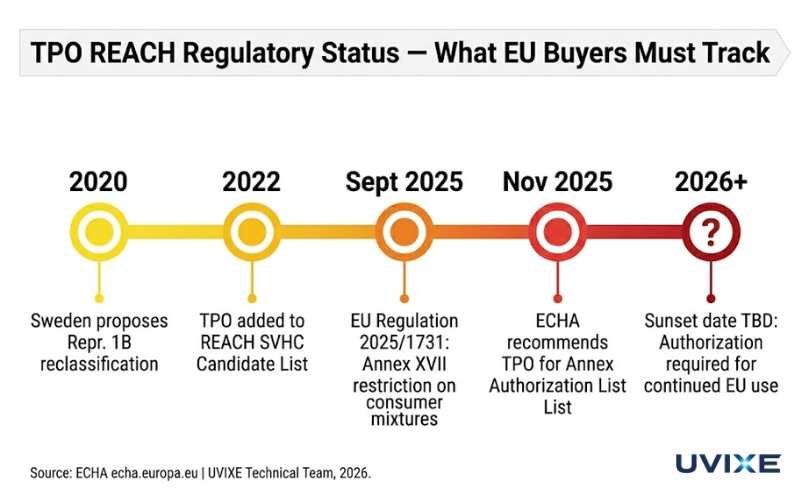
- TPO carries active EU regulatory risk in 2026. ECHA recommended it for REACH Annex XIV in November 2025. EU buyers need a documented substitution strategy now.
- For hybrid mercury + LED lines: Blend 1173 and TPO at 70/30 total loading as a validated interim step — no full reformulation required.
The Side-by-Side That Drives the Decision
Start here. Every recommendation in this article flows from these parameters.
| Parameter | Photoinitiator 1173 | Photoinitiator TPO |
|---|---|---|
| Chemical Class | Alpha Hydroxy Ketone (Norrish Type I) | Acylphosphine Oxide (Norrish Type I) |
| CAS Number | 7473-98-5 | 75980-60-8 |
| Common Synonyms | Darocur 1173, Omnirad 1173, HMPP | Darocur TPO, Lucirin TPO, Omnirad TPO |
| Absorption Peak (λmax) | ~320–340 nm | ~370–395 nm |
| Physical Form | Clear to pale yellow liquid | Pale yellow powder / granule |
| Compatible Light Source | Mercury (Hg) broadband lamp | UV LED 365 / 385 / 395 / 405 nm |
| Mercury Lamp Performance | Excellent | Good |
| UV LED Performance (365–405 nm) | Poor — negligible absorption | Excellent |
| Surface Cure | Strong | Moderate (add amine synergist) |
| Deep / Through Cure | Moderate | Excellent (photobleaching effect) |
| Typical Dosage | 2–5% w/w | 1–3% w/w |
| Yellowing | Very low | Low (photobleaches to colorless) |
| Odor | Moderate | Low |
| REACH / SVHC Status | Not listed | SVHC Candidate List + Annex XIV recommended Nov 2025 |
| Approx. FOB China Price | USD 8–14 / kg | USD 18–28 / kg |
| Standard MOQ (UVIXE) | 25 kg HDPE drum | 25 kg fiber drum (light-protected) |
Which Photoinitiator Works Best for Your Application?
Your Light Source Is the Root Variable — Check This First
Before application type, before price, before anything else: confirm your lamp’s emission peak. Everything downstream of this single number is determined.
| UV Light Source | Dominant Emission | Compatible Photoinitiator |
|---|---|---|
| Medium-pressure mercury (Hg) | 254 / 313 / 365 / 405 nm broadband | 1173, 184, TPO, TPO-L, Benzophenone |
| UV LED — 365 nm | 365 nm narrowband | TPO, TPO-L, 819 (BAPO) |
| UV LED — 385 nm | 385 nm narrowband | TPO, TPO-L, 819 |
| UV LED — 395 nm | 395 nm narrowband | TPO, TPO-L, 819 |
| UV LED — 405 nm | 405 nm narrowband | TPO, TPO-L, 819 |
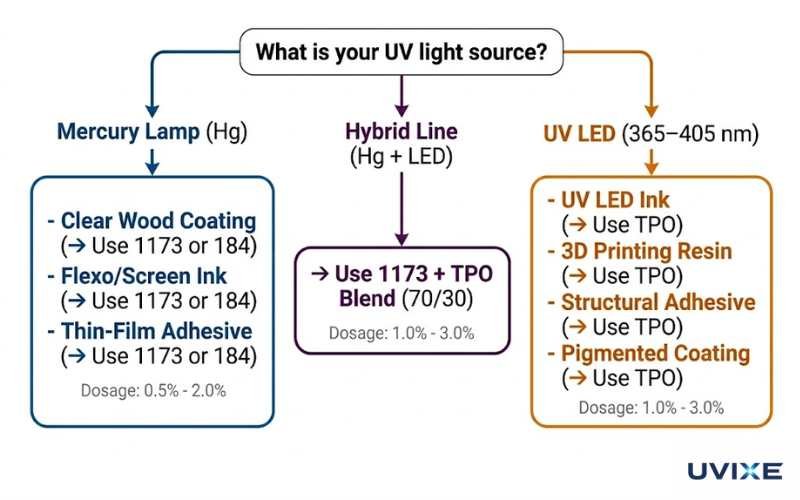
| Hybrid line (Hg primary + LED surface) | Broadband + 365–405 nm | 1173 + TPO blend (70/30) |
Mercury lamps are broadband. A single pass activates 1173 at 320–340 nm and TPO at 370–395 nm simultaneously. UV LED lamps are narrowband by engineering design. A 395 nm LED emits at 395 nm. It does not emit at 320 nm. Using 1173 as your primary photoinitiator in an LED system generates effectively zero usable radicals. You will get incomplete cure regardless of how high you push the loading.
The diagnostic takes 30 seconds. Pull your lamp specification sheet. Find the emission peak. If it falls below 360 nm, 1173 is viable as a primary initiator. At or above 365 nm, TPO must lead your photoinitiator package.
Primary Application Decision Matrix
| Application | Recommended PI | Dosage % w/w | Lamp | Primary Reason |
|---|---|---|---|---|
| Clear wood coating | 1173 or 184 | 2–4% | Mercury | Strong surface cure, very low yellowing |
| Clear wood coating | TPO | 1.5–3% | UV LED | LED absorption match; add amine synergist |
| UV offset / flexo ink | 1173 + 184 | 3–5% combined | Mercury | Fast surface cure, low migration in packaging |
| UV LED ink | TPO | 1.5–2.5% | UV LED | Direct LED absorption match |
| UV adhesive (clear, thin film) | 1173 | 2–4% | Mercury | Cost-effective, proven adhesion on glass and plastic |
| UV adhesive (structural, thick) | TPO | 2–3% | Mercury or LED | Photobleaching enables deep through-cure |
| SLA / DLP 3D printing resin | TPO | 0.3–1% | UV LED 385/405 nm | High quantum efficiency at low loading |
Extended Application Matrix
| Application | Recommended PI | Dosage % w/w | Lamp | Notes |
|---|---|---|---|---|
| White pigmented coating | TPO (± TPO-L) | 2–3% | Mercury or LED | Photobleaching overcomes TiO₂ UV absorption screen |
| UV resin casting (clear, thick) | TPO | 0.5–1.5% | UV LED | Depth cure + photobleaching preserves optical clarity |
| Screen printing ink (mercury) | 1173 + TPO blend | 2% + 1% | Mercury | Dual absorption window: surface + depth coverage |
| Hybrid line (Hg primary + LED final) | 1173 + TPO (70/30) | 3% total | Hybrid | Dual-window coverage without full reformulation |
| Food-adjacent packaging ink | 1173 (low loading) | 2–2.5% | Mercury | Lower odor risk vs benzophenone; verify migration compliance per EU Reg. 10/2011 or equivalent |
Three Procurement Scenarios Where This Decision Gets Complicated
Technical comparison articles tell you which photoinitiator is chemically correct. They rarely tell you what happens when the technically correct answer creates a procurement problem. These three scenarios come directly from conversations with our customers.
Scenario 1: Your formula is validated on TPO, and your EU customer’s compliance team flags the SVHC status mid-contract.
This happened to a coating manufacturer in the Netherlands in Q3 2024. Their automotive customer’s procurement policy required written SVHC risk disclosure for any substance on the REACH Candidate List at >0.1% in articles. TPO was in their coating at 2%. They had two options: provide the Article 33 disclosure and begin a documented substitution evaluation, or switch to a TPO-L/TPO blend to reduce TPO concentration below the threshold. They chose the blend route — 40% TPO / 60% TPO-L at equivalent total loading — and maintained cure performance within acceptable tolerance. Build your SVHC disclosure documentation before your customer asks for it. The request will come.
Scenario 2: TPO prices spike again, and you have no secondary PI strategy.
TPO peaked above RMB 300/kg during the 2021–2022 UV LED supply crunch. Buyers without a secondary formulation option had two choices: absorb the cost increase or halt production. In recent years, expanded domestic Chinese production has brought TPO prices back to around RMB 100/kg — but the supply dynamics that drove that spike (rapid LED adoption outpacing phosphine oxide production capacity) have not permanently resolved. A 70/30 1173/TPO blend at 3% total loading is a viable production buffer formula for mercury lamp lines. Maintain it as a tested fallback, not an emergency improvisation.
Scenario 3: You need to switch a customer-approved 1173 formula to TPO after an LED line upgrade.
Customer re-approval of a changed formula can take 4–12 weeks depending on the industry and the customer’s QC process. A full PI switch from 1173 to TPO constitutes a formula change that most customers in automotive, electronics, and medical device supply chains will require re-testing and re-approval. The faster path: introduce TPO as a co-initiator into the existing 1173 formula first — a 70/30 1173/TPO blend at the same total loading. This improves LED cure performance meaningfully while minimizing the formula delta that triggers re-approval. Move to a pure TPO formula on the next scheduled formula review cycle, when re-approval can be planned and resourced.
A Factory Wrote Off 800 kg Because Nobody Changed the Photoinitiator
A UV coating manufacturer supplying automotive trim factories in Pune switched their production line from medium-pressure mercury to 395 nm UV LED in early 2023. Standard capital upgrade. The energy cost reduction justified the investment within 14 months.
Nobody changed the photoinitiator formula.
They kept running 3% Photoinitiator 1173 as the primary initiator — exactly as the mercury line had run for six years. By the end of the third production week, they had written off over 800 kg of tacky, under-cured topcoat. The quality team blamed the resin batch. The equipment vendor blamed substrate adhesion. It took six weeks and a third-party formulation audit to identify the actual cause.
1173 absorbs at 320–340 nm. Their LED system emits at 395 nm. The two windows never overlap. No radicals. No cure.
They reformulated to 2% TPO with 4% acrylated amine synergist. The first trial run passed QC in full. Production resumed within 72 hours. Their photoinitiator cost per 100 kg of formula increased by approximately USD 4.20 — less than 0.3% of total batch cost. The six weeks of troubleshooting, the writeoff, and the customer delay were entirely avoidable with one correct sourcing decision before the lamp upgrade.
What Is Photoinitiator 1173 — and What Does Its Chemistry Actually Mean for Your Line?
Photoinitiator 1173 (2-hydroxy-2-methyl-1-phenyl-1-propanone) has been in commercial UV formulation since the early 1980s. It is a liquid at room temperature — clear to pale yellow, low viscosity, fully miscible in most acrylate monomers and oligomers without pre-heating or dissolution steps. For production teams handling large batch volumes, that physical form matters operationally. No weighing errors from clumping powder. No heating required. Direct addition to the mix tank.
The reaction mechanism is clean. UV light cleaves the C–C bond alpha to the carbonyl. Two radicals form. One initiates polymerization. This Norrish Type I cleavage pathway is efficient and well-documented across four decades of coating, ink, and adhesive production data.
The limitation is entirely spectral. 1173’s primary absorption window sits at 240–340 nm. Medium-pressure mercury lamps emit substantially here. UV LED arrays at 365–405 nm do not.
Where 1173 belongs:
- Clear and low-pigment wood coatings under mercury lamp
- Flexo and screen printing inks on Hg exposure units
- Thin-film UV adhesives on glass and plastic
- Systems requiring very low yellowing with no deep-cure demand
- Liquid PI handling preferred for large batch production
Where 1173 fails:
- Any UV LED line at 365–405 nm
- Heavily pigmented coatings
- Thick-section deep-cure applications
- 3D printing resins cured at 385–405 nm
What Is TPO Photoinitiator — and Why Does the Phosphine Oxide Structure Change Everything?
TPO (diphenyl(2,4,6-trimethylbenzoyl)phosphine oxide, CAS 75980-60-8) absorbs strongly in the UVA range. λmax sits at approximately 370–395 nm, with usable secondary absorption extending toward 410 nm — the precise output window of modern UV LED arrays.
At UVIXE, we supply TPO as a pale yellow powder, purity ≥ 99% by HPLC, molecular weight 348.4 g/mol. It disperses in acrylate monomers at 40–50°C and holds in solution once dissolved. Handle in subdued light — TPO begins to cleave under prolonged ambient fluorescent exposure.
Two structural advantages separate TPO from every alpha hydroxy ketone:
Efficient radical generation at LED wavelengths. When a 395 nm photon contacts a TPO molecule, cleavage produces both a benzoyl radical and a phosphinoyl radical — both reactive, both initiating. The quantum yield is measurably high relative to most Type I alternatives at equivalent loading.
Photobleaching. TPO starts pale yellow. As it cleaves during cure, the chromophore is destroyed and the fragment becomes colorless. In thick-film applications or white pigmented systems, this progressive clearing allows UV light to penetrate deeper as cure advances. For 3D printing resins, structural adhesives, and TiO₂-containing coatings, photobleaching is not secondary — it is often why TPO works where 1173 cannot.
Can You Blend TPO and 1173? What the Formulation Data Shows
Yes — and under mercury lamp systems, blending is frequently the optimal strategy. 1173 covers 240–340 nm; TPO covers 360–400 nm. Together under a broadband mercury source, you activate across more of the lamp’s total spectral output than either initiator captures alone. RadTech research by Bishop et al. confirmed that complementary multi-PI packages consistently reach full cure faster than any single initiator at equivalent total loading.
Blend Performance Reference Data
Source: UVIXE internal formulation trials, 2024. Test system: urethane acrylate (50% UA oligomer / 50% IBOA monomer), medium-pressure Hg lamp 80 W/cm, 50 µm film on glass substrate. Surface cure: thumb-twist test. Through cure: MEK double rub (pass count reported). Results are representative starting points for your own lab validation.
| Blend Ratio (1173 / TPO) | Total PI % | Surface Cure | MEK Double Rub (passes) | Through Cure | Best Fit Application |
|---|---|---|---|---|---|
| 100% 1173 (control) | 3% | Pass | >100 | 55–65 | Clear thin-film, Hg lamp |
| 75% / 25% | 3% | Pass | >100 | 70–80 | Clear coatings, general Hg lamp |
| 50% / 50% | 3% | Pass | >100 | 85–95 | Medium-pigment systems, Hg lamp |
| 25% / 75% | 3% | Pass | >100 | >100 | Thick film, pigmented, Hg lamp |
| 100% TPO (control) | 2% | Marginal* | >100 | >100 | UV LED systems, deep cure priority |
*Surface cure with 100% TPO under mercury lamp improves significantly with addition of 3–5% acrylated amine synergist. Under UV LED, add amine synergist as standard practice.
The Switching Cost Problem Nobody Talks About
If you are mid-transition from mercury to LED and cannot immediately commit to a full reformulation, the 70/30 1173/TPO blend at 3% total loading is a validated interim step. It improves LED surface cure performance without requiring full formula revision or customer re-approval in most systems. Start there. Move to a pure TPO formula on your next scheduled formula review cycle, when re-approval can be planned and resourced.
Two rules from our lab work that most blend guides omit:
Rule 1: For UV LED-only systems, blending 1173 into a TPO formula adds no cure benefit. The correct solution for surface tack under LED is an acrylated amine synergist at 3–5% — oxygen scavenging at the surface, no wasted PI cost.
Rule 2: TPO loading above 3.5% in standard acrylate systems plateaus and actively inhibits cure. Excess TPO competes with the resin for available photons, reducing penetration into the coating bulk. The optimal loading range for most LED applications is 1.5–2.5% TPO. More is not faster — above the threshold, it is slower.
Is TPO Going to Be Banned in the EU? What REACH Means for Your 2026 Supply Chain
This is the question every EU buyer and every exporter to Europe needs to answer before their next purchase order. The answer is: not yet banned, but the regulatory trajectory is unambiguous.
TPO REACH Regulatory Timeline
| Date | Event | Practical Impact |
|---|---|---|
| 2020 | Sweden proposes reclassifying TPO from Repr. Cat. 2 (H361) to Cat. 1B (H360DF) | “Suspected” reproductive toxicant reclassified as “presumed” |
| 2022 | TPO added to REACH SVHC Candidate List, 29th batch | Article 33 disclosure duties triggered for articles >0.1% w/w |
| Sept. 1, 2025 | EU Regulation 2025/1731 adds TPO to Annex XVII Appendix 6 (Repr. 1B) | TPO restricted in consumer-accessible mixtures above threshold |
| Nov. 18, 2025 | ECHA formally recommends TPO for REACH Annex XIV — Authorization List | EU use will require specific authorization if European Commission adopts recommendation |
ECHA’s 12th recommendation notes that TPO’s annual EU consumption ranges from 1,000 to 10,000 tonnes, and that the subsequent regulatory control will directly impact relevant supply chains — making the search for effective yet safer alternatives a core technical challenge for printing and coatings industries over the next few years.
As of September 1, 2025, EU Regulation 2025/1731 has already added TPO to Annex XVII Appendix 6 as a Repr. 1B substance, restricting its supply to the general public in mixtures at or above specified concentration limits.
Four Actions Your Procurement Team Needs to Take Now
Action 1 — Audit your formula. If finished articles contain >0.1% TPO by weight, Article 33 REACH communication duties already apply. You must disclose to downstream customers on request.
Action 2 — Document your substitution evaluation. ECHA’s Annex XIV authorization framework requires evidence that you assessed alternatives. A documented lab trial comparing TPO, TPO-L, and a TPO-L/819 blend is sufficient to demonstrate good faith evaluation.
Action 3 — Begin partial substitution trials. TPO-L (CAS 84434-11-7) has lower reproductive toxicity classification and similar LED absorption range. Expect to increase loading by 20–40% to compensate for lower initiation efficiency. A 60/40 TPO-L/TPO blend is a validated transitional formula — we have formulation trial data for this blend in DLP resin systems available on request. Contact us for the full trial protocol.
Action 4 — Monitor ECHA’s adoption timeline quarterly. Track the ECHA Authorization List directly. Once Annex XIV adoption is confirmed and a sunset date published, the authorization application process becomes time-critical.
Photoinitiator 1173 carries none of this exposure. It is not on the SVHC Candidate List. For EU-destined products where SVHC-clean formulation is a customer or policy requirement, 1173 passes the screen without qualification.
What Does This Choice Actually Cost Per Batch?
| Parameter | Photoinitiator 1173 | Photoinitiator TPO |
|---|---|---|
| Approx. FOB China Price | USD 8–14 / kg | USD 18–28 / kg |
| Typical Dosage | 2–4% w/w | 1–3% w/w |
| PI Cost per 100 kg Formula | ~USD 2.00–5.60 | ~USD 3.60–8.40 |
| Standard MOQ (UVIXE) | 25 kg HDPE drum | 25 kg fiber drum (light-protected) |
| Bulk MOQ | 200 kg IBC | 200 kg drum pallet |
| Lead Time — China to EU | 25–35 days sea freight | 25–35 days sea freight |
| Lead Time — China to India / SEA | 12–18 days sea freight | 12–18 days sea freight |
| Shelf Life | 24 months | 24 months (store dark, <25°C) |
| Documentation | COA, SDS, REACH statement | COA, SDS, REACH SDS, SVHC disclosure |
The cost delta per 100 kg of formula is approximately USD 1.60–2.80 in favor of 1173. Against the cost of one failed batch, one reformulation cycle triggered by wrong PI selection, or one customer rejection due to cure failure, that delta is negligible. Choose on performance and compliance fit first. Optimize cost second.
6 Questions Our Technical Team Answers Every Week
Q1: Is TPO going to be banned in the EU — and what should I do right now?
TPO is not yet banned. ECHA recommended it for REACH Annex XIV in November 2025. If the European Commission adopts this recommendation — which the regulatory trajectory strongly suggests — a sunset date will be set, after which EU use requires an approved authorization. Start your substitution evaluation documentation now. The companies that move early work on their own timeline. The ones that wait work on the regulator’s.
Q2: Can Photoinitiator 1173 replace TPO to reduce cost in a UV LED system?
No. 1173 absorbs at 320–340 nm. Your LED system emits at 365–405 nm. Zero meaningful overlap. The cure will be incomplete regardless of loading level. If cost reduction is the goal on an LED line, a lower TPO loading (1.5% instead of 3%) combined with an amine synergist is significantly more effective — and cheaper — than substituting with 1173.
Q3: What is the best photoinitiator for DLP and SLA 3D printing resins?
TPO is the standard for DLP and MSLA resins at 385–405 nm. Start at 0.3–0.5% w/w. Over-loading TPO in 3D printing systems causes excessive near-surface absorption that blocks depth cure and degrades XY resolution. Titrate upward in 0.2% increments against your specific layer thickness and exposure time. For EU-market resin products, begin evaluating TPO-L as a partial REACH-safer substitute.
Q4: What is the minimum effective TPO loading in a UV LED system — and what happens if I overdose?
The effective range for most acrylate-based LED systems is 1.5–2.5% w/w. Below 1.5%, you risk incomplete through-cure in medium and thick films. Above 3.5%, excess TPO competes with the resin for available photons — penetration into the coating bulk decreases and cure speed drops. We see this most often when formulators carry mercury-lamp dosage habits (3–5%) into LED systems without adjustment. Start at 2% and validate up or down based on your specific film thickness and lamp intensity.
Q5: What is the correct storage protocol for TPO to maintain full 24-month shelf life?
Store below 25°C, in original sealed packaging, away from all light sources — including ambient fluorescent warehouse lighting. TPO degrades with cumulative light exposure. A dark, temperature-controlled storage room is required, not open warehouse shelving. 1173 is similarly sensitive to heat and UV exposure, though somewhat more tolerant under ambient light than TPO.
Q6: Can I source both 1173 and TPO from UVIXE with matched REACH documentation for EU import?
Yes. UVIXE supplies Photoinitiator 1173, TPO, and TPO-L from a single origin with unified REACH SDS packages, lot-matched COA, and SVHC disclosure documentation formatted for EU import. Single-source procurement simplifies your supplier audit process and your customs documentation across your full photoinitiator portfolio.
When a Distributor Got the REACH Transition Right
A UV resin distributor based in Warsaw supplies small and mid-sized 3D printing material companies across Poland, Czech Republic, and Germany. In mid-2024, three of their customers began receiving advice from compliance consultants: document TPO usage and evaluate alternatives ahead of the anticipated REACH Annex XIV recommendation.
The distributor contacted us in August 2024. Two questions: Can you supply TPO-L as a partial substitute in existing DLP resin formulas? What does a reformulation trial look like in time and cost?
We shipped 500 g sample sets of both TPO and TPO-L to all three end customers simultaneously. Each sample pack included absorption spectrum overlays against their 405 nm DLP lamp output and a starting dosage adjustment: TPO-L at 1.4× the existing TPO loading to compensate for lower initiation efficiency. All three customers completed formulation trials within three weeks. Two validated a 60/40 TPO-L/TPO blend — meaningful SVHC risk reduction without full reformulation cost or customer re-approval trigger. The third required additional development time due to a proprietary oligomer interaction with TPO-L at elevated loading.
The validated transitional formula — 60/40 TPO-L/TPO blend at 1.4× total loading relative to pure TPO baseline — is available as a starting framework for your own lab trials. Contact us for the full trial protocol and dosage guidance specific to your resin system.
Total cost of the sample program: under USD 200 in product. Compliance risk reduced: substantial. Timeline controlled: entirely by the customer, not the regulator.
Request Samples and Validate Before You Commit
UVIXE supplies Photoinitiator 1173, TPO, and TPO-L — alongside 184, 819 (BAPO), ITX, and DETX — to UV coating factories, ink manufacturers, adhesive producers, and 3D printing resin companies across Europe, the Middle East, India, and Southeast Asia.
→ Request a 100–500 g Sample
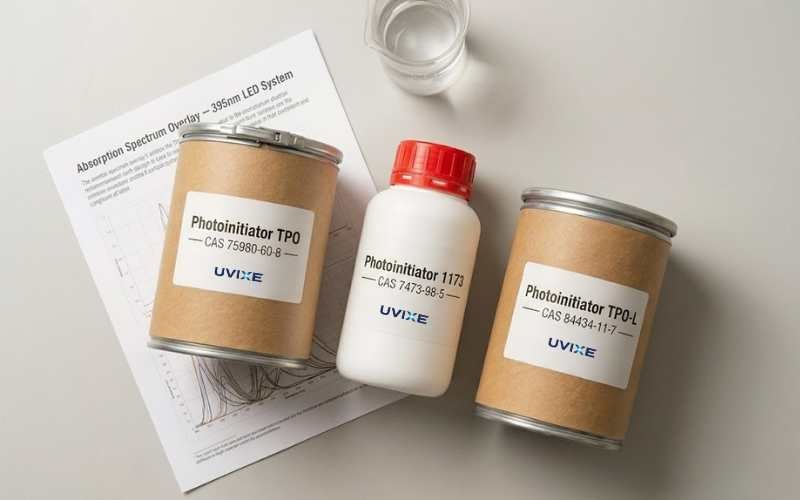
Each sample ships with an absorption spectrum overlay plotted against your declared lamp wavelength — so you validate spectral match before the first trial run, not after. COA and REACH SDS included. No MOQ on samples. Shipped within 3–5 business days ex-works.
→ Download the TPO + 1173 Technical Data Sheet Pack
Absorption curves, blend ratio guidance, dosage tables, storage requirements, and SDS in one file.
→ Get a FOB China Quotation
Confirmed pricing, lead time, and packaging options for your volume and destination port.