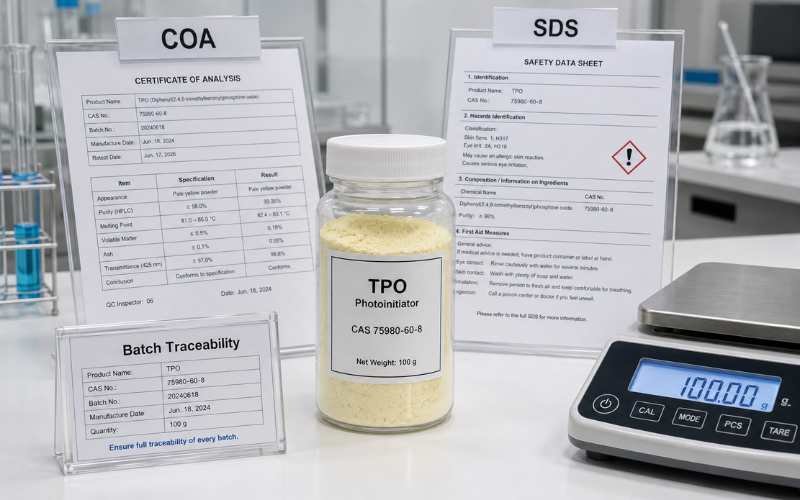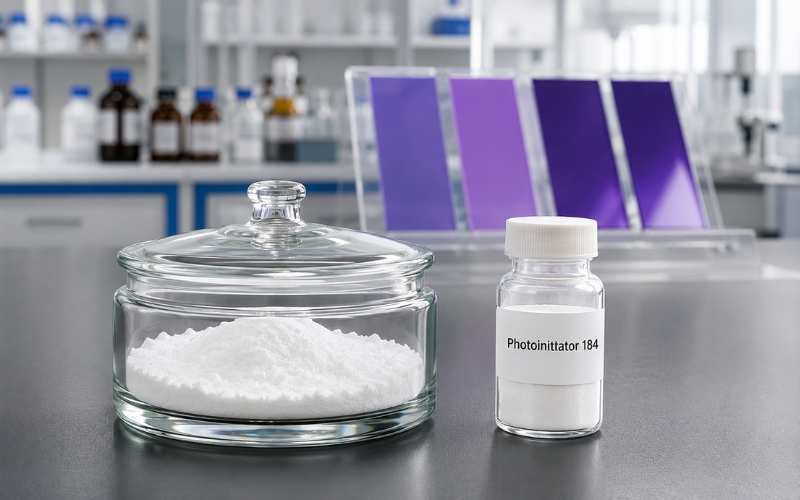
Photoinitiator 1173 is a liquid Type I α-hydroxy ketone photoinitiator used in free-radical UV curing. Its chemical name is 2-Hydroxy-2-methylpropiophenone, and its CAS number is 7473-98-5.
It absorbs UV light, forms free radicals, and starts curing in acrylate-based UV coatings, UV inks, UV adhesives, varnishes, and selected UV resin systems. Public chemical references such as PubChem’s 2-Hydroxy-2-methylpropiophenone page confirm its chemical identity, while Sigma-Aldrich’s 2-Hydroxy-2-methylpropiophenone reference describes it as a radical photoinitiator for UV radiation crosslinking.
Use Photoinitiator 1173 when:
- The UV system is clear or lightly pigmented
- The coating or adhesive layer is thin to medium
- The UV source is a mercury lamp or near 365 nm
- Low yellowing and liquid dosing matter
- You need a practical photoinitiator for UV coating, OPV, or clear adhesive production
Avoid using Photoinitiator 1173 alone when:
- The system is black, white, or heavily pigmented
- The film is thick
- The line uses 395–405 nm UV LED curing
- Deep cure matters more than surface cure
- Your customer requires special food-contact, medical, or migration approval
At UVIXE, I normally treat Photoinitiator 1173 as a strong starting point for clear UV systems, not as a universal answer. Before I recommend it, I ask for lamp wavelength, film thickness, resin type, pigment level, and target market.
Introduction: Why Buyers Should Not Choose 1173 by Habit
A UV coating stays tacky. A light-color ink cures slowly. A clear varnish turns yellow after aging. The buyer then searches “What is Photoinitiator 1173?” and starts comparing prices for CAS 7473-98-5.
That is where many procurement mistakes begin.
Photoinitiator 1173 is useful, but it cannot fix every UV curing problem. If the lamp wavelength is wrong, the pigment blocks UV light, or the film is too thick, adding more 1173 may only increase odor, yellowing, and failed batch risk.
This guide is written for UV coating factories, UV ink plants, UV adhesive producers, 3D printing resin companies, distributors, and technical buyers. I will explain what Photoinitiator 1173 is, when to use it, when to avoid it, how it compares with 184, TPO, TPO-L, and 819, and how to source it without creating production risk.
Quick Decision Table: Should You Use Photoinitiator 1173?
If you are shortlisting Photoinitiator 1173 for a production formula, start here.
| Buyer Scenario | Use 1173? | Why |
|---|---|---|
| Clear UV coating with mercury lamp | Yes | Strong fit for surface cure and low yellowing |
| Overprint varnish | Yes | Liquid handling and clear film performance help production |
| Thin clear UV adhesive | Yes | UV can pass through the adhesive layer more easily |
| Light-color UV ink | Test first | Pigment level may affect cure speed and color |
| White UV ink | Not alone | Titanium dioxide can block UV penetration |
| Black UV ink | Not alone | Carbon black can strongly reduce UV transmission |
| Thick UV adhesive | Test blend | Cure depth may be weak with 1173 alone |
| 365 nm UV LED coating | Test first | It may work if UV dose and film thickness match |
| 395–405 nm UV LED system | Usually not first choice | TPO-L, TPO, or 819 often deserves earlier testing |
| 405 nm 3D printing resin | Usually not alone | Longer-wavelength photoinitiators may fit better |
| Distributor stock for UV coating buyers | Good | Stable demand exists for clear coatings and varnishes |
UVIXE engineer note: When a buyer sends me only “price for 1173,” I cannot judge the right product. I need the curing system. Lamp wavelength, pigment loading, film thickness, and end-use market decide whether 1173 is enough.
What is Photoinitiator 1173?
Photoinitiator 1173 is a liquid Type I free-radical photoinitiator used to start UV curing in acrylate systems. It is also known as 2-Hydroxy-2-methylpropiophenone, 2-Hydroxy-2-methyl-1-phenylpropan-1-one, or CAS 7473-98-5.
After Photoinitiator 1173 absorbs suitable UV light, it splits and forms free radicals. These radicals start polymerization in UV-curable acrylate monomers and oligomers. The liquid coating, ink, adhesive, or varnish then changes into a cured film.
Industrial buyers use Photoinitiator 1173 in:
- UV coatings
- UV inks
- UV adhesives
- Overprint varnishes
- Clear lacquers
- Acrylate-based UV resin systems
- Selected 3D printing resin trials
IGM Resins describes Omnirad 1173 as a low-yellowing Type I photoinitiator used to initiate radical polymerization of unsaturated oligomers such as acrylates after UV exposure. That description matches the main industrial role of Photoinitiator 1173.
For sourcing details, you can review UVIXE’s Photoinitiator 1173 supplier page.
Photoinitiator 1173 Technical Snapshot
| Item | Typical Information | Buyer Meaning |
|---|---|---|
| Product name | Photoinitiator 1173 | Common UV curing raw material name |
| Chemical name | 2-Hydroxy-2-methylpropiophenone | Used in technical and regulatory records |
| CAS number | 7473-98-5 | Key identity for COA, SDS, customs, and audits |
| Type | Type I free-radical photoinitiator | Generates radicals directly after UV absorption |
| Chemical family | α-hydroxy ketone | Often used in clear and low-yellowing UV systems |
| Physical form | Liquid | Easier dosing and blending than many solid photoinitiators |
| Appearance | Colorless to slightly yellow liquid | Important for clear coatings and varnishes |
| Molecular formula | C10H12O2 | Chemical identity reference |
| Molecular weight | About 164.2 g/mol | Useful for technical documentation |
| Main application | UV coating, UV ink, UV adhesive, varnish | Strong fit for clear and low-pigment systems |
| Common concern | Cure depth in thick or pigmented systems | May need TPO-L, TPO, or 819 blend |
| Documents to request | COA, SDS, TDS, REACH/RoHS if required | Needed for approval, shipment, and customer audits |
Do not approve a bulk order by this table alone. Use it as a screening tool. Final approval should come from COA review, SDS review, lab testing, pilot production, and customer requirement checks.
When Should You Use Photoinitiator 1173?
Use Photoinitiator 1173 when your formula needs a clean liquid photoinitiator for fast UV curing and low-yellowing performance.
It is often a strong choice for:
- Clear UV coating
- Wood UV coating
- Plastic UV coating
- Metal UV clear coat
- Paper overprint varnish
- Thin clear UV adhesive
- Light-color UV ink
- Low-pigment acrylate systems
The biggest practical advantage is handling. Because 1173 is liquid, production teams can dose and blend it more easily than some solid photoinitiators. That matters in factories with frequent batch changes, small mixing tanks, or limited heating and dissolving control.
UVIXE engineer note: In clear varnish and coating tests, I do not look only at cure speed. I also check liquid color, final film color, odor, surface tack, hardness, adhesion, and yellowing after heat aging. A fast cure that fails aging is not a pass.
When Should You Avoid Using 1173 Alone?
Avoid using Photoinitiator 1173 alone when the system needs strong through cure, long-wavelength absorption, or high pigment penetration.
Common weak-fit cases include:
- White UV ink
- Black UV ink
- Thick pigmented coating
- Filled UV adhesive
- Thick adhesive bonding layer
- 395 nm UV LED curing
- 405 nm UV LED curing
- Pigmented 3D printing resin
This does not mean Photoinitiator 1173 has no value in those systems. It means it should not be the only photoinitiator without careful testing. Many industrial formulas use a package, not a single photoinitiator.
A blend may combine 1173 for surface cure with TPO photoinitiator, TPO-L photoinitiator, or Photoinitiator 819 BAPO for deeper curing.
How Does Photoinitiator 1173 Work in UV Curing?
Photoinitiator 1173 works by Type I cleavage. After it absorbs UV energy, it splits into reactive free radicals. These free radicals start the polymerization of acrylate monomers and oligomers.
The chemistry is fast, but the factory result depends on the whole curing window.
You must check:
- UV lamp wavelength
- Lamp intensity
- Lamp aging condition
- Line speed
- Film thickness
- Resin and monomer reactivity
- Pigment or filler loading
- Oxygen inhibition
- Substrate transparency
- Coating temperature
A common mistake is simple: the surface feels tacky, so the formulator adds more Photoinitiator 1173. Sometimes this helps. Sometimes it creates new problems.
Too much photoinitiator may increase:
- Odor
- Yellowing
- Migration risk
- Brittle film behavior
- Storage instability
- Customer compliance concerns
UVIXE engineer note: When a customer reports tacky surface, I first ask about lamp condition and line speed. Old lamps and fast conveyor speeds cause more problems than many buyers expect.
Photoinitiator 1173 for UV Coatings
Photoinitiator 1173 is often a good fit for clear UV coatings. It supports fast cure and helps formulators build low-yellowing clear films when the full formula is well designed.
Common UV coating uses include:
- Clear wood coating
- Plastic protective coating
- Metal clear coating
- Paper varnish
- High-gloss OPV
- Low-yellowing lacquer
For UV coating factories, I recommend a practical test matrix.
| Test Item | Why It Matters |
|---|---|
| Surface tack | Confirms surface cure |
| Pencil hardness | Checks cured film strength |
| Adhesion | Confirms bonding to substrate |
| MEK rub | Tests solvent resistance |
| Gloss | Protects final appearance |
| Yellowing index | Critical for clear and light-color coating |
| Heat aging | Finds delayed color shift |
| Storage stability | Checks formula behavior before production |
If your coating is clear, thin, and mercury-lamp cured, Photoinitiator 1173 deserves testing early. If your coating is thick, filled, or LED-cured at 395–405 nm, test a blend.
Photoinitiator 1173 for UV Inks
Photoinitiator 1173 can work in UV inks, but it performs best in clear varnishes and light-color inks. It should not be treated as a standalone answer for heavy pigment systems.
Pigments change everything. They absorb, reflect, and scatter UV light. White ink and black ink are especially difficult.
| UV Ink Type | 1173 Fit | Buying Advice |
|---|---|---|
| Clear OPV | Strong | Test gloss, odor, rub resistance |
| Light-color ink | Moderate to good | Check cure speed and color shift |
| White UV ink | Weak alone | Test TPO-L, TPO, or 819 blend |
| Black UV ink | Weak alone | Deep cure is the main risk |
| Thick ink layer | Weak alone | Through-cure testing is required |
| LED UV ink | Often limited alone | Match photoinitiator to LED wavelength |
For ink buyers, the right question is not “Can 1173 cure ink?” The better question is “Can 1173 cure my pigment system at my line speed?”
Photoinitiator 1173 for UV Adhesives
Photoinitiator 1173 can fit thin, clear UV adhesives. It works best when UV light can pass through the adhesive layer and the substrate.
Typical test areas include:
- Thin acrylate adhesive
- Clear industrial bonding
- Plastic-to-plastic bonding
- Glass or transparent substrate bonding
- Fast fixture adhesive systems
Thick adhesive layers need more caution. If UV light cannot reach the deeper area, the adhesive may look cured near the surface but remain weak inside.
For UV adhesive approval, test:
- Cure depth
- Bond strength
- Residual tack
- Yellowing after aging
- Odor after cure
- Substrate adhesion
- Storage stability
- Customer compliance needs
Do not assume Photoinitiator 1173 is suitable for medical, food-contact, or sensitive electronics applications without a separate regulatory review.
Photoinitiator 1173 for 3D Printing Resin
Photoinitiator 1173 can be tested in some UV resin development work, but it is not usually my first choice for 405 nm SLA, DLP, or LCD resin.
Many modern 3D printing systems use 385 nm or 405 nm light sources. In those systems, TPO-L, TPO, or 819 may offer a better wavelength fit.
| 3D Printing Resin System | 1173 Fit | Better Test Direction |
|---|---|---|
| 365 nm clear resin | Testable | 1173 may work in clear systems |
| 385 nm resin | Test carefully | Compare with TPO-L and 819 |
| 405 nm clear resin | Usually not alone | Test TPO-L or 819 |
| Pigmented resin | Weak alone | Longer-wavelength package needed |
| Thick cured section | Weak alone | Cure depth is the main concern |
For resin companies, I suggest small-batch screening first. Do not move directly to bulk approval because the CAS number looks familiar.
Photoinitiator 1173 vs 184 vs TPO vs TPO-L vs 819
Photoinitiator 1173 is often compared with 184, TPO, TPO-L, and 819. These materials are not interchangeable in every formula.
| Photoinitiator | Form | Strong Point | Best Fit | Main Caution |
|---|---|---|---|---|
| 1173 | Liquid | Easy dosing, low yellowing, surface cure | Clear coatings, OPV, thin adhesives | Weak alone in deep or pigmented cure |
| 184 | Solid | Low yellowing, clear systems | Coatings and varnishes | Needs dissolution control |
| TPO | Solid | Longer-wavelength absorption | LED UV and pigmented systems | Color and compliance review needed |
| TPO-L | Liquid | LED fit and liquid handling | UV LED coatings, inks, adhesives | Cost and formula match matter |
| 819 / BAPO | Solid | Strong deep cure | Thick, filled, pigmented systems | Color impact and cost need testing |
1173 vs 184
1173 and 184 are both common photoinitiators for low-yellowing UV systems. The main practical difference is form. 1173 is liquid. 184 is solid.
Choose 1173 when liquid dosing and faster mixing matter. Choose 184 when your formula already handles solid photoinitiators well and your production process controls dissolution.
For a focused comparison, read UVIXE’s Photoinitiator 1173 vs 184 guide.
1173 vs TPO
1173 fits many clear mercury-lamp systems. TPO often fits longer-wavelength UV LED systems and deeper cure needs.
Choose 1173 for clear coating, OPV, and thin adhesive systems. Choose TPO when your formula uses 385–405 nm LED curing or contains more pigment.
For a buyer-focused comparison, see UVIXE’s TPO vs Photoinitiator 1173 page.
1173 vs 819
819, also called BAPO, is often selected for deep cure in thick or pigmented UV systems. It is not always the best choice for clear low-yellowing coating because color and cost may matter.
Use 1173 when the film is clear and thin. Test 819 when cure depth is the main problem.
Is Photoinitiator 1173 Suitable for UV LED Curing?
Photoinitiator 1173 can be tested near 365 nm UV LED, but it is usually not the best standalone choice for 395–405 nm UV LED curing.
This is where many factories fail. They move from mercury lamps to LED curing but keep the old photoinitiator package. The coating surface may look dry. The film below may remain weak.
| UV Source | 1173 Suitability | Buyer Action |
|---|---|---|
| Mercury UV lamp | Good in many clear systems | Strong starting point |
| 365 nm UV LED | Testable | Check intensity and film thickness |
| 385 nm UV LED | Limited to moderate | Compare with TPO-L or 819 |
| 395 nm UV LED | Often limited alone | Test longer-wavelength package |
| 405 nm UV LED | Usually weak alone | TPO-L or 819 often fits better |
| Thick pigmented film | Weak alone | Deep-cure package required |
For production safety, UV curing lines also need correct shielding, ventilation, and operator protection. References such as RadTech’s UV/EB curing safety resources and SAIF’s UV radiation safety guidance are useful for factories that operate UV curing equipment.
Is Photoinitiator 1173 the Same as Omnirad 1173, Darocur 1173, or Irgacure 1173?
Photoinitiator 1173 is the generic chemical identity. Omnirad 1173, Darocur 1173, and Irgacure 1173 are commercial naming or historical brand-related references used in the market.
For procurement, do not approve an alternative source only by name similarity. Check the chemical identity, CAS number, COA, SDS, appearance, purity data, and performance in your own formula.
Buyers often search:
- Omnirad 1173 alternative
- Darocur 1173 alternative
- Irgacure 1173 equivalent
- CAS 7473-98-5 supplier
- 2-Hydroxy-2-methylpropiophenone supplier
- Photoinitiator 1173 China supplier
A responsible supplier should not claim brand equivalence without proof. The safer buying logic is this: confirm CAS identity, request documents, test samples, and approve performance in your own UV system.
UVIXE engineer note: When a distributor asks for an Omnirad 1173 alternative, I ask what their customer is using it for. A clear OPV buyer and a 405 nm resin buyer should not receive the same recommendation.
Recommended Dosage and Testing Logic
There is no universal dosage for Photoinitiator 1173. Final dosage depends on resin structure, monomer reactivity, lamp output, film thickness, pigment loading, and final performance targets.
Many UV systems test photoinitiators in low single-digit percentage ranges. But the exact amount must come from supplier guidance, lab testing, and production trials.
| Application | 1173 Testing Logic | Do Not Ignore |
|---|---|---|
| Clear UV coating | Start with supplier TDS guidance | Yellowing, hardness, adhesion |
| OPV | Test surface cure and odor | Blocking, gloss, rub resistance |
| Thin UV adhesive | Test cure depth and bond strength | Residual tack and aging |
| Light-color UV ink | Test cure speed and color shift | Pigment blocking |
| White or black UV ink | Do not rely on 1173 alone | Through cure |
| 3D printing resin | Use screening matrix | Wavelength and cure depth |
Do not approve a photoinitiator only because the surface dries fast. A serious test should check the whole cured film.
TCO: Why Cheap Photoinitiator 1173 Can Become Expensive
The lowest price per kg can become the highest cost in production. Photoinitiator 1173 affects batch stability, customer approval, rework, audit documents, and delivery timing.
If a UV coating factory uses 800 kg of coating per day and a 2% photoinitiator package fails, the loss is not just the price of 16 kg of photoinitiator. The real loss may include resin, monomer, substrate, machine time, labor, rework, delayed shipment, and customer complaint handling.
| TCO Factor | Low-Price Risk | Better Buying Question |
|---|---|---|
| Unit price | Looks attractive first | Does it pass your formula test? |
| Batch color | May affect clear coatings | Is appearance stable batch to batch? |
| COA quality | Weak data delays approval | Is COA provided for each batch? |
| SDS | Missing SDS blocks audits | Is the latest English SDS available? |
| Packaging | Leakage or contamination | Is packaging export-ready? |
| Lead time | Late supply stops production | Is stock or production timing clear? |
| Customs documents | Shipment delay | Can the supplier support export documents? |
| Rework | Failed batch cost | Has the sample passed pilot production? |
The EPA low- and no-VOC/HAP coatings guidance lists UV-cured coatings as one example of compliant low/no VOC/HAP coating systems. That helps explain why UV curing has strong industrial value. Still, low VOC does not remove the need for chemical control, SDS review, and safe handling.
How to Choose a Photoinitiator 1173 Supplier
A good Photoinitiator 1173 supplier should reduce production risk. A weak supplier only sends a price.
Before you place a bulk order, check three areas.
Product Quality Checklist
- Correct product name and CAS number
- Stable liquid appearance
- COA for each batch
- SDS and TDS available
- Export-ready packaging
- Batch traceability
- Sample support
- Clear shelf-life guidance
Trade Support Checklist
- Practical MOQ
- Real lead time
- Packaging options
- Incoterms clarity
- Destination country experience
- Customs document support
- Fast response before and after order
- Label information for warehouse handling
Technical Support Checklist
- Can discuss UV coating, ink, adhesive, and resin systems
- Can compare 1173 with 184, TPO, TPO-L, and 819
- Can explain where 1173 is not suitable
- Can support sample testing
- Can provide documents before shipment
- Does not promise universal performance
UVIXE supplies Photoinitiator 1173, Photoinitiator 184, TPO photoinitiator, TPO-L photoinitiator, Photoinitiator 819 BAPO, ITX, DETX, 907, and 369 for UV coating, UV ink, UV adhesive, resin, and distributor buyers.
FAQ About Photoinitiator 1173
What is Photoinitiator 1173?
Photoinitiator 1173 is a liquid Type I free-radical photoinitiator used to start UV curing in acrylate coatings, inks, adhesives, and varnishes.
It is also called 2-Hydroxy-2-methylpropiophenone, and its CAS number is 7473-98-5.
What is the CAS number of Photoinitiator 1173?
The CAS number of Photoinitiator 1173 is 7473-98-5.
Buyers should use this CAS number when checking COA, SDS, customs documents, and supplier quotations.
Is Photoinitiator 1173 a Type I photoinitiator?
Yes. Photoinitiator 1173 is a Type I photoinitiator that forms free radicals directly after UV absorption and molecular cleavage.
This makes it useful in many free-radical acrylate UV curing systems.
What is Photoinitiator 1173 used for?
Photoinitiator 1173 is used in UV coatings, UV inks, UV adhesives, overprint varnishes, clear lacquers, and selected UV resin systems.
It works best in clear, light-color, thin, or low-pigment systems.
Is Photoinitiator 1173 good for clear UV coating?
Yes. Photoinitiator 1173 is often a good choice for clear UV coatings where low yellowing, liquid handling, and fast surface cure matter.
Buyers should still test yellowing, gloss, hardness, adhesion, and aging.
Can Photoinitiator 1173 be used in UV ink?
Yes, Photoinitiator 1173 can be used in some UV inks, especially clear varnish and light-color ink systems.
It is usually not strong enough alone for white, black, thick, or heavily pigmented UV inks.
Can Photoinitiator 1173 be used in UV adhesive?
Yes. Photoinitiator 1173 can work in thin clear UV adhesives where UV light can pass through the adhesive layer.
For thick or filled adhesives, test a blend and check cure depth carefully.
Is Photoinitiator 1173 suitable for 405 nm UV LED curing?
Photoinitiator 1173 is usually not the best standalone choice for 405 nm UV LED curing.
For 395–405 nm systems, compare it with TPO-L, TPO, or 819 before approval.
What is the difference between Photoinitiator 1173 and 184?
Photoinitiator 1173 is liquid, while Photoinitiator 184 is solid.
Both can be used in low-yellowing UV systems, but 1173 often gives easier dosing and faster blending.
What is the difference between Photoinitiator 1173 and TPO?
Photoinitiator 1173 is often used in clear mercury-lamp systems, while TPO is often stronger in longer-wavelength UV LED and deeper-cure systems.
Choose by wavelength, pigment level, film thickness, and final performance target.
Does Photoinitiator 1173 yellow?
Photoinitiator 1173 is often selected for low-yellowing systems, but final yellowing depends on resin, dosage, UV dose, heat aging, additives, and film thickness.
Do not judge yellowing by the photoinitiator alone.
What documents should I request before buying Photoinitiator 1173?
Request COA, SDS, TDS, product label information, and REACH or RoHS statements if your market requires them.
For audited customers, ask for these documents before shipment, not after cargo is ready.
Where can I buy Photoinitiator 1173 in bulk?
You can source bulk Photoinitiator 1173 from UVIXE, a China-based photoinitiator supplier for UV coating, UV ink, UV adhesive, resin, and chemical distribution buyers.
Send your application details before asking only for price.
Final Buying Advice: Do Not Buy 1173 as a CAS Number Only
Photoinitiator 1173 is a practical liquid photoinitiator for clear UV coatings, overprint varnishes, thin UV adhesives, and some light-color UV inks. It offers easy handling, fast curing, and low-yellowing potential in the right system.
But it is not a cure-all.
If your formula uses heavy pigment, thick film, 395–405 nm LED curing, or strict migration requirements, test other photoinitiators such as 184, TPO, TPO-L, or 819 before bulk approval.
My advice is direct: approve Photoinitiator 1173 by formulation logic, not habit. Check the lamp, film, resin, pigment, documents, supplier reliability, and pilot production result.
That is how you avoid failed batches, delayed shipments, and painful customer complaints.
Before You Buy Photoinitiator 1173, Send UVIXE Your UV Line Details
Do not send only “price for 1173.” Send us your curing system.
When UVIXE receives your lamp wavelength, film thickness, resin type, pigment level, destination country, and required documents, we can help you decide whether Photoinitiator 1173 is enough or whether you should compare 184, TPO-L, TPO, or 819.
Please include:
- Target application
- Current photoinitiator package
- Lamp type and wavelength
- Film thickness
- Clear or pigmented system
- Monthly quantity
- Destination country
- Required documents
- Packaging requirement
- Expected lead time
UVIXE supplies Photoinitiator 1173, 184, TPO, TPO-L, 819, ITX, DETX, 907, and 369 for industrial UV curing buyers.
You can contact us through the UVIXE contact page or request product details from our Photoinitiator 1173 supplier page.